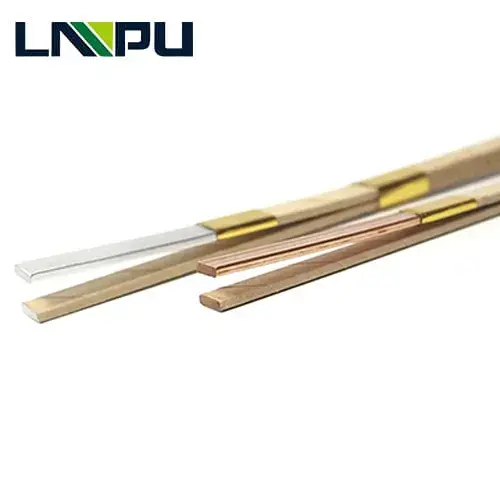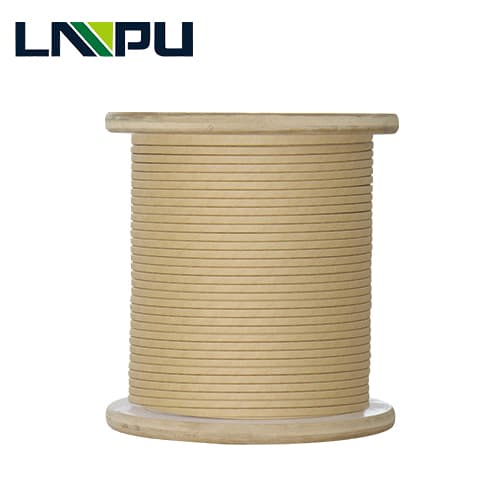
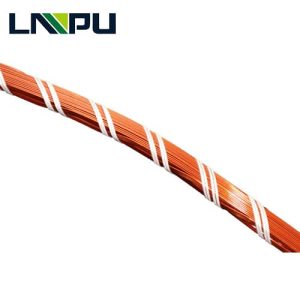
What is Continuously Transposed Conductor Without Paper?
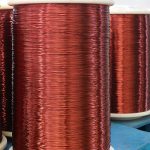
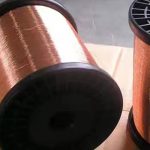
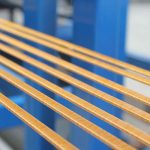
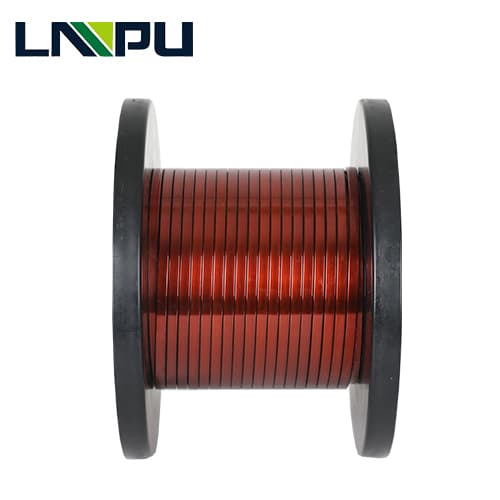
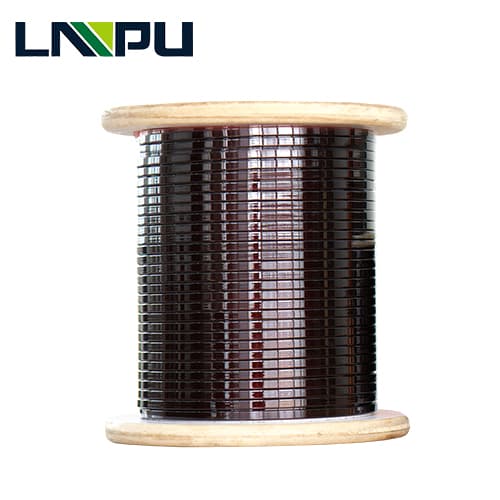
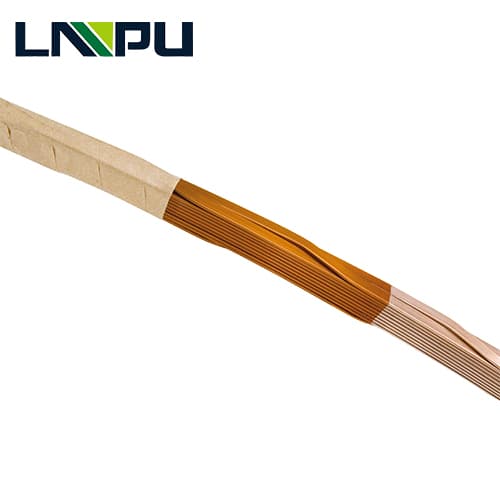
Continuously Transposed Conductor Without Paper is one of CTC Winding that composes of serveral enameled flat copper wire for HV systems. The different type of enamels provide the insulation of each single conductor. The number of conductors includes an odd number from 5 up to 81. Transposed cable divides into paper insulated conductor and CTC without paper.
Furthermore, the main CTCs’ feature is that each conductor, successively and repeatedly, transposes through every possible position in the entire conductor cross-section, in a rotating movement. During the transposition, each single conductor stays parallel to the others, without any twist.
Manufactured without paper, using a tie cord replacing
NETTING TAPE: the polyester net uses in the place of tie cord.
CTC Technical parameters:
| Parameter | Metric Range (mm) | Tolerance | Standard / Notes |
| Single Conductor Thickness (a) | 0.90 – 3.15 mm | ± 0.01 mm | Single strand thickness |
| Single Conductor Width (b) | 2.50 – 13.00 mm | ± 0.01 mm | Single strand width |
| Width-to-Thickness Ratio (b/a) | 2.0 < b/a < 9.0 | — | Recommended ratio for optimal transposition integrity |
| Max Bundle Dimensions | Height max: 120.0 mm | ± 0.05 mm | Excluding outer netting |
| Width max: 26.0 mm | |||
| Enameled Coating Thickness | 0.08 – 0.12 mm | ± 0.005 mm | Double-sided enamel coating thickness |
| Bonding Epoxy Layer Thickness | 0.03 – 0.05 mm | ± 0.005 mm | Self-adhesive layer (B-Stage Epoxy) |
| Transposition number | 5 – 81 (odd or even optional) |
| Common Wrapping insulation material | Electric kraft paper /High densityinsulation paper / Thermallyupgraded insulation paper/ High stretch fiber paper / Nomex paper or according to client’ srequirement |
| Standard | IEC,NEMA,GB,JIS |
| Packing | Ply- wooden spool or according to client’s requirement |
| Appication | largeoil immersed power transformers,reactors and large capacity dry-type transformers. |
Three insulation thermal classes are available: Inveform 120ºC, Inveterm 180ºC and Invemid 220ºC. Enamelled single rectangular conductors are produced according to the standards IEC 60851 test methods, IEC60317-0-2 General Requirements, IEC 60317-18 (INVEFORM 120) and IEC 60317-28 (INVETERM 180) and NEMA-MW 38C (INVEMID 220).
The bondable over coating allows adhesion of the strands after heat treatment at 120°C 24 h. The bondable over coat has a shelf life up to 8 months (or up to 6 months for treatment at 110°C 48 h) for storage at temperature not greater than 32°C. Good bonding result achieves in laboratory specimens after treatment at 130°C for 16 hours or 120°C for 24 hours or 100°C for 48 hours
Why Choose Paperless / Net-Covered CTC Cable?
| Key Features | Traditional Paper-Covered CTC | Paperless (Netting Tape / Tie-Cord) CTC | Engineering Advantage |
| Cooling Efficiency | Insulation paper restricts oil circulation | Direct exposure to transformer oil | 15%–25% Thermal Dissipation Improvement |
| Hot-Spot Temperature | Higher local temperature buildup | Uniform heat evacuation | Reduces insulation degradation, extends transformer life |
| Space Factor | Paper layers increase total dimensions | Minimal thickness added by mesh netting | Higher winding space factor, smaller core size |
| Eddy Current Loss | Standard reduction | Optimized for high-frequency HV systems | Reduces overall load losses ($P_k$) |
Thermal Class & Insulation of Continuously Transposed Conductor
Thermal Insulation Classes
Class 120 (Inveform/ Polyvinyl Acetal- PVF): IEC 60317-18 specification. Good mechanical strength and outstanding transformer oil resistance.
Class 180 (Inveterm/Polyesterimide+Polyamideimide (PEI+PAI): Conforming to IEC 60317-28. Thermal endurance for heavy-duty operational loads.
Class 220 (Invemid / Polyamide-imide – PAI): Meets NEMA MW 38C / IEC 60317-26 specifications. Due to its unique characteristics, it is used in dry-type transformers for extremely high temperatures, as well as for specialty traction transformers.
Bondable Overcoat (B-Stage Epoxy Resin) Specifications
Single strands may be coated with a heat-curable B-Stage Epoxy resin for high short-circuit strength.
Shelf Life: 6 to 8 months or longer, if stored at storage temperature < 32ºC (89.6ºF).
Bonding / Curing Conditions:
Since it is more practical to dry this wheat over standard 24 hours (120 acceleration for 24 hours in transformer drying oven Standard curing cycle)
130°C for 16 hours (Accelerated curing cycle)
100°C for 48 hours (Low-temperature prolonged cure).
Bond Strength: inter-strand shear strength 4.5 MPa (room temperature, fully cured)
Quality Assurance & Testing Standards
All 100% of our Paperless CT conductors are tested extensively according to IEC 60851 test procedures:
Dielectric Breakdown Volt Test: Confirmed strand-to-strand insulation stability under high voltage within the oil.
Springback & Flexibility Test Demonstrates the stability of pitch length and absolutely no cracking of enamel while winding small diameter coil.
Adhesion & Heat Shock Test: This was carried out at 200 ºC to avoid any delamination while the transformer was being assembled quickly.
Oil Compatibility Test: Zero degradation or no chemical dissolution when immersed in mineral transformer oil or synthetic ester at 140ºC for 168 hrs.
Typical Applications of CTC Winding
Large Oil-Immersed Power Transformers (EHV / UHV Substation Transformers)
High-Voltage Traction Transformers for High-Speed Railway Locomotives
Shunt & Series Reactors requiring high dynamic short-circuit withstand capabilitiesHigh-Capacity
Dry-Type Transformers operating under space-constrained conditions
When ordering Continuously Transposed Conductors, the following information are requested:
- number of strands and their nominal dimensions
- type of copper and type of enamelled wires (with or without bondable epoxy varnish)
- minimum winding diameter
- total paper thickness and paper type
- interleaving paper and its thickness
- required length and type of drum