
What are the Fiberglass Insulation Materials for Magnet Wire?
The dominant groups of insulations used on magnet wire are film (enamel) and Fiberglass (served or wrapped) insulations. Film insulations consist of a layer of polymer applied directly onto the conductor surface, in very thin bonds 0.02 – 0.08 mm thick per build. Fiberglass insulations consist of a layer (or layers) of textile material wrapped around the conductor.
Of the Fiberglass insulations in widespread use today, paper and glass fiber are the most common. Both are wrapped, not extruded or coated (this is actually an advantage as it allows use on nearly any conductor cross-section – round, rectangle, or square). With these insulations, large power transformer windings and high-torque motor builds are easily achieved.
Fiberglass insulation offers several advantages over enamel alone:
Increased mechanical protection against abrasion, chipping and damage during handling and during the winding process
More resistance to the effects of thermal shock and overload conditions
Refined compatibility for vacuum pressure impregnation (VPI) process.
Easier strippability in many configurations. Thus reducing labour cost at termination.
Fiberglass coverings are also applied over a base film coating, for the purposes of providing a composite insulation system that takes advantage of the dielectric strength of the enamel together with the toughness of a Fiberglass material.
Paper Insulating Material for magnet wire
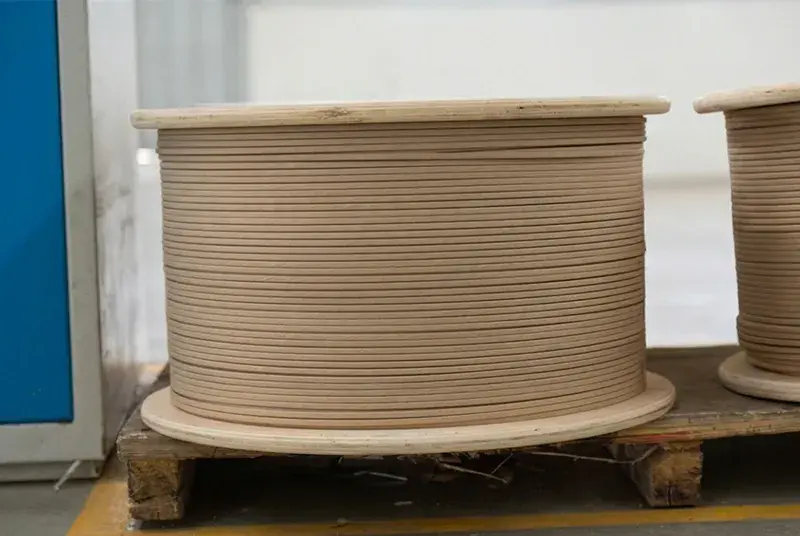
The insulating material shall be rope paper, Kraft paper, or both. The paper covering shall be of one or more tapes wrapped firmly, closely, evenly, and continuously around the wire. The use of a suitable adhesive material shall be permitted.
Adherence and flexibility: covering shall not loosen appreciably nor open sufficiently to expose the bare wire after bending around a mandrel having a dimension 6 times the thickness of the bare wire
Kraft Paper and Rope Paper
The types of paper insulation specified in the NEMA and IEC standards for magnet wire are Rope paper and Kraft paper or a combination of the two. The selection of paper as an insulation material has been in use for over one hundred years in electrical winding applications; however, in oil impregnated transformers the paper is used in conjunction with dielectric liquid to improve the type of insulation system.
Kraft paper for magnet wire insulation is not typical packaging type of grade. It requires the electrical-grade purity (low ash content, moisture pickup and tensile property distribution). Long term behavior of Kraft paper used in oil cooled transformer was well established for a lifetime of 30~40 years depending upon the operating temperature.
Nomex (Aramid) Paper
Induction heating reaches the limits of conventional Kraft paper (around 105 degrees C (Class A)) and a higher performing paper is required. Nomex aramid paper developed by Du Pont is a meta – aramid synthetic fiber that can withstand utilization temperatures at or up to 220 degrees C (Class C) and excursions for very short periods to around 400 degrees C.
The most commonly used grades for magnet wire applications are:
Nomex 410 The baseline electrical-quality Nomex, a good compromise between dielectric strength, mechanical toughness and thermal endurance. Commonly used for dry-type transformer windings and motor slot liners.
Nomex 414 A heavier Nomex providing enhanced mechanical strength under compression. Used in transformer winding when a heavier Nomex is needed, especially where short-circuit forces are significant.
Nomex 418 A Nomex based composite sheet that incorporates polyester or foil layers for better flexibility and improved dielectric properties.
Nomex paper has such a high thermal resistivity that a Class C (220 degreesC) transformer design can be substituted for a Class H (180 degreesC) design with markedly increased margin. This risk reduces the size and weight of the transformer valuable in traction, aerospace and offshore applications.
Structure and features for paper insulation materials
Single or Double with underlying film: no cracks visible in the film insulation after 20% elongation. Examine with normal vision and without removing the glass fiber covering.
Double without underlying film: not less than 75 V/mil (2950 V/mm) of
minimum thickness of the glass fiber covering on one side. See paper covered wire types
Paper Covering Construction Standards
More comprehensive rules for the construction of paper covered magnet wire are given in NEMA MW 1000 and IEC 60317. The essential requirements are:
Adhesion and flexibility: The wrapping should not be loosened significantly or exposed the bare conductor after bending around a mandrel of a diameter six times the wire thickness. This verifies the cover geometry and the adhesive bonding are suitable for normal winding operation.
Wrap geometry: With tape stack, some tapes are wound all in the same way, while other tapes are wound in a opposite way. Allowable overlap area percentage defines the number of insulation layers, as per the equation:
Dimensional increase the increase in conductor diameter caused by the tape cover is limited by these equations:
| Percentage of Overlap | Equivalent Tape Layers (×n tapes) |
| 0% | n |
| >0 to 25% | 1.33n |
| >25 to 33% | 1.50n |
| >33 to 40% | 1.67n |
| >40 to 50% | 2.0n |
| >50 to 67% | 3.0n |
| >67 to 75% | 4.0n |
For plain carbon and low carbon aluindustrie, the minimum increase in diameter, is;
Maximum increase in diameter = 2x (N + 1) x t
Where N= number of layers, t=nominal tape thickness
These tolerances can have significant impacts on slot-fill calculations for motor and transformer design. In winding window dimensions, designers will need to specify for the maximum case.
Glass fiber Insulating Material for magnet wire
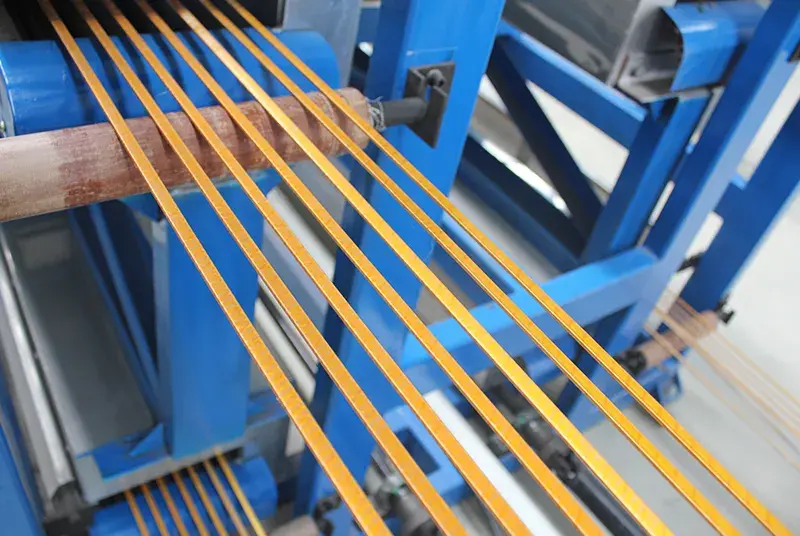
Furthermore, the glass fiber shall be electrical-grade continuous-filament glass yarn. If an underlying film coating is used, it shall have at least a class 130 rating and comply with the applicable Part 2 specification. The glass
fiber covering shall be wrapped firmly, closely, evenly, and continuously
around the wire. The glass fiber covering shall be treated with an
insulating varnish to provide a tough outer finish. see fiberglass covered wire types
Electrical-Grade Glass Fiber
Electrically-equal (E-glass) continuous-filament yarn, not chopped strand or woven fabric, is used in glass fiber insulation for magnet wire. As explained by the ASTM Standard on the subject, ‘The use of filament yarn has been found crucial because of the consistency and smoothness of the wrap, and the elimination of fiber end exposure points that would lower surface insulation resistance.
A single bunch of glass fiber yarn is made up of hundreds to thousands of individual filaments, each only several microns to 20 microns in diameter that is between 1/20 and 1/5 the diameter of a human hair! The fine filament structure is exactly what makes the wrapped wire smooth to the touch but also provides the interlocking mechanical structure necessary to resist abrasion.
Unlike paper, glass fiber as a reinforcement material provides substantially different properties:
Inorganic composition resistant to moisture absorption, not subject to hydrolysis degradation
High melting point glass has no fixed melting point since amorphous, so does not begin to soften until very high temperatures that it will not be exposed to within a reasonable range of the coil
Superior corrosion resistance resistant to nearly all common solvents, oils and industrial chemicals.
Good mechanical strength in tension individually fibers are very strong but brittle if kinked.
The major compromises are that the glass fiber is more brittle than paper or polymer films and shows worse abrasion resistance at fiber crossover points at cyclic flexing.
Varnish Treatment and Composite Constructions
According to NEMA and IEC practices, the glass fiber covering is dipped in an insulating varnish in order to form a tough external coating. This coating is expected to perform numerous functions, such as holding the yarn in position, filling the air voids for the dielectric strength, and providing moisture and abrasion protection to the surface of the glass.
The choice of available varnishes influences the chemical environment suitability as well as the thermal class value of the final product:
Polyester varnish (for instance 7.12.0031) for Class 130 (B) or Class 155 (F) application; adhesives and flexible
You do not need a varnish if the lamination is pressurized!
Epoxy varnish – increased chemical resistance and mechanical hardness. For industrial motor windings in conditions where solvent may be present
Silicone varnish it can be used for Class 180(H) and above ratings; good thermal stability, resistant to water penetration. Also the most used for high performance power windings
Construction Variants
Glass fiber covered magnet wire is produced in several standard configurations:
Single Glass (SG): One layer of glass fiber yarn applied over the bare or enameled conductor. This is the minimum build, and provides moderate mechanical protection with a small overall diameter.
Double Glass (DG): “two layers of glass fiber wound back-winds in opposite directions in order to cover the maximum possible area in order to supply maximum strength symmetry mechanically”. Cross- lay construction produces a better physical properties then a unidirectional single wrap.
Glass on Enamel: The prevalent industrial build, where the glass fiber is laid above a film-insulated feeder conductor. Enamel guarantees the principal dielectric strength (absence of pin-holes) whilst the overserve delivers crushing and thermal shock resistance as well as good impregnation adhesion. For this construction the underneath film must be rated at a minimum Class 130 (B) according to specification.
Polyglass / Dacron-Glass: Hybrid construction of Polyester-fiberglass blended yarn of trade names Polyglass, Dacron, SPG, DPG by different makers. The blends exhibits better flexibility and fatigue resistance compared to 100% glass and hence are used in applications where vibration / cyclic flexing are involved. The temperature rating of 155 degreesC or 180 degreesC can be provided depending on varnish system.
Dimensional and Dielectric Requirements
For glass fiber covered wire with a bare film coating, NEMA MW 1000 requires the dielectric strength over a bare film coating to be at least 75 V/mil (2,950 V/mm) measured on a single surface of the minimum glass fiber thickness. This test demonstrates sufficient insulation integrity of the varnish fiber combination in absence of the enamel undercoat.
For glass-over-enamel constructions, the test becomes: there shall be no visible cracks in the film insulation after 20% elongation when viewed through normal vision, without removal of the glass fiber covering.
Thermal Class Mapping: Paper vs. Glass Fiber vs. Enamel
The most critical selection factor for any magnet wire insulation system is the thermal class. The NEMA and IEC classification system identifies the thermal class with the maximum temperature the insulation can handle (in degrees Celsius) over an anticipated service life of 20,000 hours without a reduction of greater than 50% of the baseline mechanical strength.
Key design note: Thermal class of final insulation system can be different from the components. The system rating is made by the weakest series, working at maximum thermal stress location. Glass over enamel wire with class F enamel and Class H silicone varnish is still class F unless with tested and rated system
Requirements
Fibrous coverings shall be wrapped firmly, closely, evenly, and continuously around the wire. When more than one tape covering is applied, adjacent tapes shall be permitted to be wound in the same or in opposite directions. The relation of the percentage of overlap of the tape to the number of layers of tape is shown as follows:
The increase in diameter due to the tape covering for round tape-covered wire, and the increase in thickness due to the tape covering for rectangular and square wire, and are determined as follows:
Minimum thickness or diameter increase = 2(0.85)Nt
Maximum thickness or diameter increase = 2(N+1)t
Where:
N: Quantity of layers n: Quantity of tapes
t: tape thickness (nominal)
The increase in width of square and rectangular wire due to the tape covering shall be equal to or less than the increase in thickness.
NOTE 1—The calculated maximum increase due to tape covering may be exceeded provided the measured overall dimension of the covered wire does not exceed the sum of the specified maximum conductor or film insulated thickness or diameter plus maximum increase due to covering.
NOTE 2—Number of tapes or layers, tape thickness, sides of application of fluorinated polymer adhesive, when applicable, and percentage of overlap are agreed on between user and supplier.
Thermal Class Mapping: Paper vs. Glass Fiber vs. Enamel
Thermal class is by far the most important selection criterion for any magnet wire insulation system. Both NEMA and IEC define thermal classes in terms of Celsius temperature sustained by the insulation for a typical 20,000 hour expected service life without a mechanical strength reduction of more than 50% from the original baseline strength.
| tdermal Class | Temperature (°C) | Common Paper Option | Common Glass Fiber Option |
| A | 105 | Kraft paper | — (rarely used) |
| B | 130 | Kraft paper | Glass/polyester varnish |
| F | 155 | NMN composite laminate | Polyglass/epoxy varnish |
| H | 180 | Nomex 410/414 | Glass/silicone varnish |
| C | 220 | Nomex (witd suitable system) | Glass/silicone (composite) |
Another important design point is that the thermal class of the final insulation system may be different than the individual materials. The system rating is based on the weakest component operating at the highest thermal stress point. An enamel-over-glass wire using a Class F and Class H is not rated higher than Class F unless the full system has been tested and rated.
NEMA and IEC Standards: What Engineers Need to Know
Identifying paper and glass fiber insulated magnet wire involves knowing the relevant standards. The standards are:
NEMA MW 1000 (North American market): This is the unified magnet wire specification from the National Electrical Manufacturers Association, which establishes construction standards, test procedures and dimensional tolerances for both paper and fibrous-covered conductors. The MW-series designations (e.g. MW 15, for square or rectangular paper covered wire) are widely used in transformer and motor performance specifications.
International IEC 60317: IEC standards series designed by the IEC (the International Electrotechnical Commission) for specific types of winding wire; (part 28) Glass-fiber (single or double) enameled copper and aluminum wire; (part 12) Paper covered winding wire.
Key test requirements shared across both frameworks include:
Flexibility / adherence: Mandrel bend test (6x wire thickness) without loosening or bare-conductor exposure
Dielectric strength: 5kV/mm test on the fibrous covering wall
Elongation (glass-over-film): No film breaks are visible after 20% elongation
Dimensional compliance: Measured overall diameter within maximum increase tolerance (3.5%)
Buyers and engineers should verify which standard their supplier or certifies to, because the dimensional tolerances and test acceptance criteria may vary in IEC vs NEMA for the same nominal product.
Frequently Asked Questions
Q. What is the difference between paper covered and glass fiber covered magnet wire?
Paper covered wire, utilizing rope paper or Kraft paper (including Nomex aramid paper) over the conductor, is used primarily in oil-immersed transformers and applications where ease of stripping is important. Glass fiber covered wire has electrical grade continuous filament glass yarn covered with insulating varnish, giving the highest mechanical protection, moisture resistance, and wide choice of high-temp varnish systems through 200 degreesC and higher. Selection will depend on thermal class, environment and mechanical needs.
Q: What thermal class is glass fiber covered magnet wire?
Glass fiber covered magnet wire is manufactured to available in various thermal classes according to its varnish system. Polyester based varnishes can produce Class 130 (B) or Class 155 (F). Epoxy based varnish can produce Class 155 (F). Silicone based varnish, Class 180 (H) and advanced silicone systems on suitable enamel substrates, Class 200 (C). The thermal class has to be confirmed with the wire manufacturer according to the final construction.
Q: Is it possible to put some type of glass fiber insulation over the enameled wire?
Yes this is by far the most common construction in industrial motor and transformer winding. The enamel acts as the pin-hole free dielectric coverage; the glass fiber overserve gives added mechanical strength, thermal shock tolerance and impregnation assistance. IEC and NEMA specifications call for a minimum Class 130 (B) rating of the base film in this structure after a 20% elongation.
Q: Which types of papers are permitted to be used as insulation for magnet wire by the NEMA specifications?
NEMA MW 1000 (from 2002) states: insulating material shall be rope paper, Kraft paper or combination of these. Nomex (aramid) paper satisfies the requirements of the higher thermal class (200 degree C) and is commonly used for Class H (180 degree) or Class C (220 degree) conditions. The paper covering should be wound closely, evenly and without distortion around the wire with optional use of a binder.
Q: How do I find the increase in diameter for the tape covered Magnet wire?
Standardformulas are such as: minimum diameter increase= 2 x (0.85) x N x tmax diameter increase= 2 x (N + 1) x twhere N is number of layers and t is the Nominal tape thickness. Percentage of overlap will also determine the effective number of insulation layers. A half overlap for just one tape provides two equivalent layers of insulation. Calculations for slot-fill and dimensional tolerances should be based on the appropriate overlap-to-layer ratio, as given in NEMA MW 1000.
Q: Is Nomex paper same as Kraft paper for transformer winding?
No although they are both in paper form they are no comparison as one is a cellulose paper and the other a synthetic film. Kraft paper (cellulose) is rated (class A) to 105 degreesC and is ideal in an oil immersed transformer where it acts as part of the dielectric system by effecting dielectric oil absorption (it will largely just hold dielectric oil). Nomex (synthetic) (class C) is rated to 220 degrees C, it can be used in air cooled transformers and does not seek to absorb dielectric oil so it is highly thermally resistant but expensive.