
Introduction
The thermal class of magnet wire is the standardized rating that tells you the maximum continuous operating temperature a wire’s insulation can withstand over a design life of 20,000 hours. It is arguably the most critical specification engineers and procurement teams need to get right when selecting magnet wire for motors, transformers, solenoids, and other wound components.
This guide covers everything you need to know: how thermal classes are defined, which standards govern them, what insulation materials correspond to each class, how to select the right rating for your application, and the key differences between IEC, NEMA, and UL classification systems.
What Is the Thermal Class of Magnet Wire?
The thermal class of magnet wire — also called the temperature rating or thermal index — defines the maximum temperature at which the wire’s insulation can perform reliably over an extended service life. It is expressed in degrees Celsius and is assigned based on standardized aging tests, not simply the heat resistance of the raw polymer.
According to NEMA MW-1000 and IEC 60172, two conditions must be satisfied before a thermal class can be assigned to a magnet wire:
a)Temperature index must show an extrapolated life for the wire of 20,000 hours or more at or above the thermal class rating.
b)Heat shock capability as required in standard. This shall be at least 20ºC higher than the Thermal Class temperature.
The thermal class that is specified on each product is the class of the magnet wire and is not intended as the class of electrical equipment it is used in.
This distinction is significant. ‘The thermal class is the operating temperature limit –- not the maximum survival temperature. For instance, a Class H (180 degreesC) wire has to be able to survive a heat shock test at a temperature of at least 200 degreesC. The thermal class specified for each product is the class of the magnet wire alone and is not meant to signify the thermal class of the entire electrical device in which it is used.
Key Takeaways:
Thermal class=20,000 hour design life maximum continuous temperature
Heat shock threshold (> 20 degreesC above class temperature)
Rating pertains to the wire not the end use equipment
Note of aluminum and copper
It is expected that the magnet wire producer will supply the user, on request, with test data in support of the thermal class of the magnet wire offered as meeting the requirements of IEC, NEMA or clients’ requirement Standard.
NOTE 1—Copper will oxidize at an increasing rate at temperatures of 200°C and above and will also pit and become brittle at such temperatures. This oxidation will eventually damage the film coating, and failure of the winding may result. Where extended life is desirable at temperatures exceeding 200°C, it is advisable to protect the copper conductor with a material such as silver or nickel, provided the material is compatible with the film coating or covering.
NOTE 2—Aluminum magnet wire often exhibits a higher thermal index and different heat shock properties in comparison with film-coated copper magnet wire. These differences should be considered when assigning the thermal class to film-coated aluminum magnet wire.
Why Thermal Class Matters for Engineers and Procurement Teams
The risks associated with the incorrect thermal class for the application are both safety and economic. Under specifying thermal class carries the risk of faster thermal aging, inter-turn shorts and winding failure. If the thermal class is over specified then this adds additional cost and in some case can reduce winding density if the insulation build is excessively high.
Thermal aging is governed by the Arrhenius rule. Practically, this translates into a reduction of the insulation life-time of about 50% for each temperature increase of 10 degreesC above the rated one. In case a winding is operating 20 degreesC above its insulation rated class, the life-time predicted will decrease from 20,000 hours to about 5000 hours (around 75%).
Cost is another major factor. The transition from a Class F (155°C) polyesterimide wire to a Class H (180°C) polyesterimide/polyamide-imide system would generally add 15 30% to the cost of the wire materials. The extra outlay is justified, but only if the application warrants it. By carrying out a systematic thermal analysis prior to the selection of the wire it is possible to avoid both under-designing and excess expenditure.
Electrical equipment must pass a certification audit. There are many international standards for electrical equipment that require this, including UL 1446, IEC 60085, and NEMA MW-1000. Each standard mandates that the insulation system of electrical equipment be rated for a thermal class equal to the operating conditions that the equipment is expected to operate within. Incorrect ratings can lead to failed audits.
Standard Thermal Classes
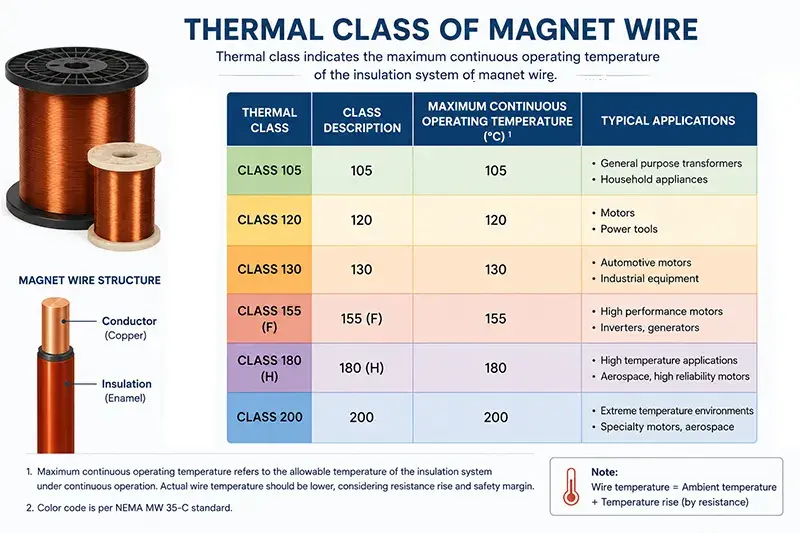
IEC 60085 and NEMA MW-1000 agree on a uniform series of thermal classes, each of which has a certain maximum continuous operating temperature. The table below depicts this entire grade scale, with the older letter grades still long established as broadly in use.
The thermal classification of electrical insulating varnishes shall be based on one of the following methods:
—Electrical in conjunction with magnet wire (ASTM D3251)
—Mechanical in conjunction with magnet wire (ASTM D3145)
—Weight loss (ASTM D3377 or ASTM D2756)
—Electrical on glass cloth (ASTM D1932)
—Field history
The most common classes in industrial motors and transformers are the Class F (155 degrees C) and H (180 degrees C). Class B (130 degrees C) had been the most common standard for many years and still survives in older equipment and rewind uses. In more severe operating conditions, (high performance servo drives, inverter duty motors, traction applications, aeronautic etc.) this is rising to Class H or higher.
It is important to point out that the highest commercially available thermal class for regular film-insulated copper magnet wire (class-155) is 250 degreesC. The higher the temperature, the more high-performance materials (e.g., nickel- or silver-coated conductors with ceramic or high-polymer insulation) that are needed.
Insulation Materials by Thermal Class
Conductor and dielectric material dictates the insulation thermal class. Conductor is like most other wires, but the dielectric material is a single or double polymer film coating of very thin layers applied multiple times. The material classification to a thermal class:
Class A and Class E (105 °C – 120°C )
Polyvinyl formal (Formvar) and polyvinyl butyral are the archetypal products in the class. They are now rarely used, overtaken by much higher rated polymers, but persist in some old designs, relays, and lower-heat consumer electronics.
Class B (130°C )
Polyester (PE) is the default class of insulation used at this class. It is a low cost material that is readily available and covers a wide range of applications including fractional-horsepower motors, small transformers and domestic appliances. It offers very good dielectric strength but moderate chemical resistance relative to higher class materials. Class F(155 degreesC):
Polyesterimide (PEI) is the workhorse at Class F. It provides high thermal operating capability, high mechanical strength in winding and insertion and low friction – critical in high speed automated winding processes. PEI is the most specified wire for modern industrial motors, HVAC compressors, power tools and general purpose transformers.
A Class F example that is widely used is PEI with a nylon (polyamide) overcoat that provides enhanced cut-through and chemical resistance for severe environments.
Class H (180 degrees °C )
Polyamide-imide (PAI) overcoat on a polyesterimide base is the typical dual-coat system at this class. The PEI base provides the thermal performance, while the PAI overcoat provides the higher cut-through resistance, scratch and solvent resistance. Class H wire is the specification of choice for:
Motors used on inverter-duty.
Hermetics found in refrigeration and HVAC…
High-ambient-temperature industrial motors
Electric traction motors for automotive and rail applications
A straight polyamide-imide without the PEI base exists as well, replicating the performance of Class H with outstanding mechanical toughness.
Class N and Above (200 °C – 250 °C )
Insulation systems for Polyimide (PI) e.g. ML wire (trade name) is for all Class 200 and above. Polyimide has the highest dielectric strength, very good chemical solvent resistance and stability at very high and low temperatures. It is used for aerospace windings, military specification equipment, dry type power transformers and high-energy servo motors.
A further point of detail for copper conductors: at 200 deg. C and above, the oxidation of copper speeds up and copper begins to p it‘s, developing a picture and becoming brittle. If long service life is required above 200 deg. C (say), then it makes sense to specify silver protected or nickel protected copper conductors for compatibility with the film coating.
Metalized aluminum magnet wire: Slightly different thermal index and heat shock behavior than copper. Aluminum, for the same thermal class, sometimes has a higher thermal index than the corresponding thermal class copper wire thus requiring a clear communication when choosing the thermal class of aluminum conductors.
How Thermal Class Is Tested and Verified
Temperature class designation is much more than a material specification; it is derived from accelerated test data performing at not less than 3 different elevated temperatures with statistical regression analysis.
The process:
The wire samples are coiled around mandrels and aged at high temperature (generally 3-4 temperatures above the anticipated class temperature).
After every aging cycle the samples are checked for electrical breakdown (twisted pair test) for failure.
All time-to-failure data at each temperature will be plotted on an Arrhenius type plot (log time vs. 1/temperature).
A regression is fitted to the data and extrapolated as it is estimated that 50% would fail at each temperature.
The temperature at which the extrapolated 20,000 hour life falls is called the wire‘s temperature index (TI), and it is the number used to determine the thermal class.
Heat shock testing is carried out independently. The wire is wound on a mandrel and then bent or twisted to induce a winding force. The wire is then subjected to rapid temperature variations. The wire must survive a combination of mechanical-thermal stress: the dielectric breakdown test is performed on the wire. The temperature of the heat shock test must be a minimum of 20 degreesC above the wire‘s thermal class temperature.
Magnet wire manufacturers should be able to provide test data regarding the thermal class upon request in accordance with IEC, NEMA or customer standards.
Common Thermal Class Specifications by Application
| Application | Typical tdermal Class | Common Insulation System |
| Household appliance motors | Class B (130°C) | Polyester |
| General-purpose industrial motors | Class F (155°C) | Polyesterimide |
| HVAC compressor motors | Class H (180°C) | PEI + PAI |
| Inverter-duty motors | Class H (180°C) | PAI witd inverter-duty coating |
| EV traction motors | Class H–N (180–200°C) | PEI + PAI or polyimide |
| Dry-type transformers | Class F–H (155–180°C) | Polyesterimide or polyimide |
| Aerospace/military windings | Class C (220°C+) | Polyimide (ML wire) |
| Oil-cooled traction transformers | Class H–N (180–200°C) | PEI + PAI or polyimide |
The Role of Thermal Class in Motor Rewinding
For motor repair shops and OEM rewind operations, thermal class selections have direct warranty, reliability and liability consequences. A frequent and expensive mistake is to re-wind with a “like-for-like” wire spec based on original manufacture date alone without considering whether the original thermal class was sufficient for the application as it has been in operation.
It is usual practice to use equal or higher class thermally than the original wire when rewinding a motor an upgrade from Class B to Class F or Class H for example will generally mean a low increase in material cost and a correspondingly longer service life, especially in a motor operating under thermal load.
A few things to keep in mind: increasing the thermal class do not make the wire gauge and number of turns in the winding correct. Only the insulation material is affected by the thermal class, the wire gauge and the winding geometry define electrical properties.
Test Procedure – Thermal Endurance of Magnet Wire
The thermal endurance of all film-insulated sizes and shapes shall be evaluated using 10-29 AWG round Heavy (or Type 2) magnet wire.
Thermal class ratings shall be based on tests performed on unvarnished specimens of round wire with a heavy film coating prepared and tested in accordance with ASTM D 2307. The preferred round wire size for evaluation is 18 AWG round Heavy Build insulation. Thermal classifications for rectangular and square magnet wires are based on the thermal endurance results of round wire sizes 10-18 AWG. Wire sizes 28 or 29 AWG shall be permitted for use when the specification’s size range is limited to 25 AWG and finer.
Experience has shown that film-insulated wire and electrical insulating varnishes or resins can affect one another during the thermal exposure process. It is possible that interaction between varnish or resin and film insulation will increase or decrease the relative thermal life of the varnish and film insulated wire combination compared with the life of the film insulated wire tested without varnish.
The conductor type or the surface condition of the conductor will affect the thermal endurance of film-insulated magnet wire.
In essence, the temperature index is a nominal or relative value expressed in degrees Celsius at 20 000 h. It is for comparison only, not representing the film wire’s operating temperature.
Frequently Asked Questions
Q: Which thermal class is used most in industrial motor magnet wire?
A: Class F (155 degreesC) is the most prevalent thermal class today for modern industrial motors. It is the default thermal classification required by most motor OEMs for general purpose and HVAC use. A Class H (180 degreesC) is gaining popularity in inverter-duty and high ambient temperature applications.
Q: How does the thermal class differ from the temperature index?
A: The temperature index (TI) is the actual, numerical value obtained by the ASTM D2307 test the temperature, in degreesC, where the insulation reaches an extrapolated 20,000-hour life. The thermal class is the rating assigned based on the TI. For example, a wire with a TI of 185 degreesC would be given a thermal Class H (180 degrees C).
Q: Is it safe from a thermal point of view to specify a heavier thermal class wire?
A: Absolutely. Always specify a higher class wire than necessary. From a thermal point of view, it‘s always safer. Practically, the balancing point is cost: the more expensive higher class wire produces a more expensive build; in certain designs with very limited slot fill, a heavier build on the higher class wire will slightly reduce winding density.
Q: Is the thermal class different for aluminum vs. Copper magnet wire.
A: The method of assigning a thermal class is identical, however alumowire frequently has a higher thermal index than similarly coated copper wire owing to differences in the chemistry of the conductor surface and how it interacts with the film insulation. NEMA MW-1000 specifically mentions adjustments that should be made when assigning a thermal class to film coated alumowire.
Q: The rules governing thermal class testing.
A: Main standards are ASTM D2307 for thermal endurance test, IEC 60172 the world wide equivalent, NEMA MW-1000 standard for North American magnet wire and IEC 60085 thermal classification of insulation; insulation systems of electrical equipment is covered by UL 1446.
Q: What occurs when a motor winding is above its thermal class temperature?
A: Insulation degradation exponentially increases above the rated temperature per the Arrhenius equation.. A back-of-the-envelope approach: for every 10 degreesC above the rated class temperature, the remaining insulation life is cut in half. Overtemperature operation over time results in windings that become embrittled and cracked, allowing inter-turn electrical shorts, resulting in winding failure.
Conclusion
The thermal class of a magnet wire is more than a catalogue specification; it is the engineering basis for winding reliability, equipment life and regulatory conformance. To specify it correctly you need to know: how thermal classes are characterized and tested, how the chemistry of the insulation relates to its temperature capability, and how application-specific stress factors like duty cycle, drive type, chemical environment and mechanical loading influence thermal design.
Most standard industrial motor applications will use Class F (155°C) polyesterimide wire as the standard baseline. Inverter duty, hermetic, and high ambient applications will use Class H (180°C). Stringent military aerospace and power equipment applications will utilize Class C (220°C+) polyimide systems.
References: NEMA MW 1000 and ASTM D2307