
AWG size
The nominal American Wire Gauge (AWG) bare wire diameter in inches is calculated using the basic mathematical characteristics of the AWG rounded to the nearest 0.0001 in.:
X = (0.0050)(1.1229322)(36-N)
Where:
X = nominal bare wire diameter in inches to be determined
0.0050 = nominal base diameter in inches for 36 AWG
1.1229322 = 39√92 = the ratio of the diameter of any AWG size to the (smaller) diameter
of the next larger AWG size
36 = the AWG number of the base diameter
N = the equivalent AWG number of X, where N is normally a whole number
For sizes 4/0 to 2/0 AWG, N is a negative number from -3 to -1
In the case where the nominal bare wire diameter is known, the AWG size is calculated as follows:
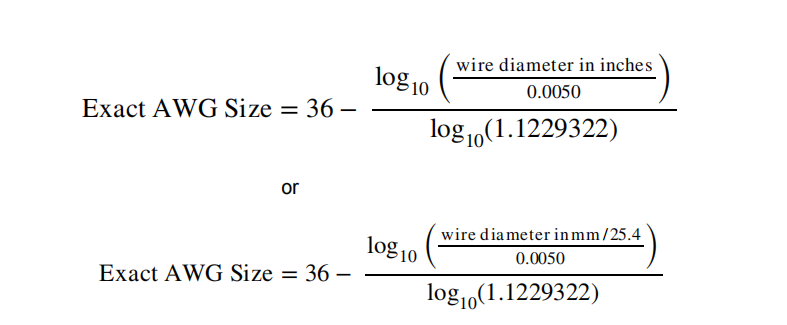
NOTE—The minimum and maximum bare diameters in inches are calculated as follows:
2-13.5 AWG film-insulated round wire (see AWG wire size chart):
Minimum Bare Diameter = Nominal Bare – 1%
Maximum Bare Diameter = Maximum Film Insulated OD – (Minimum Film Increase + 0.0003 in.)
These special maximum bare dimensions have been established to avoid bare wire diameter values that, when combined with the Minimum Film Increase, would lead to ODs greater than the Maximum
Film Insulated OD or eliminate any manufacturing tolerances. Both the Minimum Film Increases and the Maximum Film Insulated ODs were previously established Standard values that must be maintained. The
maximum bare diameter in the above formula shall be allowed to be exceeded up to the nominal bare diameter +1% provided the maximum overall diameter of the film insulated product is not exceeded.
Otherwise:
1/0-44 AWG Nominal Bare ±1%, according to ASTM B3
Maximum bare OD may exceed nominal by up to 1% if the maximum film insulated OD is maintained.
How to measure awg size in mm? How to measure wire guage in mm?
To determine the American Wire Gauge (AWG) of a wire, you can use a wire gauge tool, or measure the wire’s diameter with calipers or a micrometer. A wire gauge tool is the most straightforward method, featuring slots corresponding to different AWG sizes. Alternatively, measure the wire’s diameter and consult an AWG chart or formula, according to the University of Illinois.
- Measuring wire gauge with calipers
Select a wire gauge tool with slots labeled with AWG sizes.
Strip the wire’s insulation if present.
Insert the wire into the slots until you find the one where it fits snugly, without being too loose or too tight.
The corresponding AWG number on the slot is the wire’s gauge. - Calipers or Micrometer:
Strip the wire’s insulation.
Use calipers or a micrometer to measure the wire’s diameter, avoiding the part under screws if applicable.
For stranded wire, ensure the strands are tightly bundled together for an accurate measurement.
Consult an AWG chart or use the formula: D(AWG) = 0.005 * 92^((36-AWG)/39) inch, according to the University of Illinois. - Insulation Markings:
Examine the wire’s insulation for markings that may indicate the AWG size.
For example, “18 AWG” printed on the insulation clearly indicates the wire’s gauge.
What is the formula for AWG to MM? How to measure awg size calculator?
AWG sizes with multiple zeros can be designated as number of zeros or number of zeros/0. Both metric wire cross-section and wire outside diameter can be calculated by formulas using just the AWG number.
The formula for the wire outside diameter is: 0.127 mm * 92(32-n)/39 [mm]
The formula for metric wire cross-section is: 0.012668 mm2 * 92(36-n)/19.5 [mm2].
In both formulas, n is the AWG number.