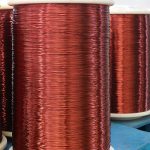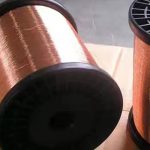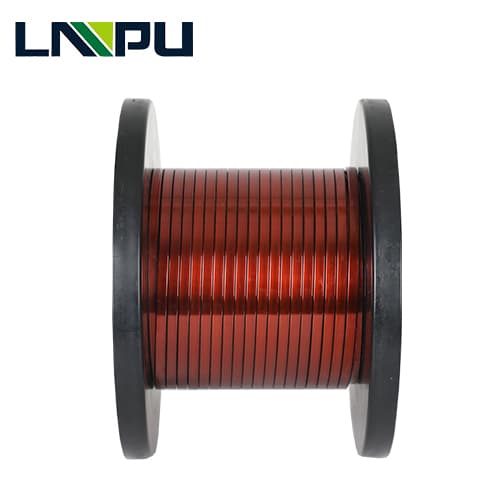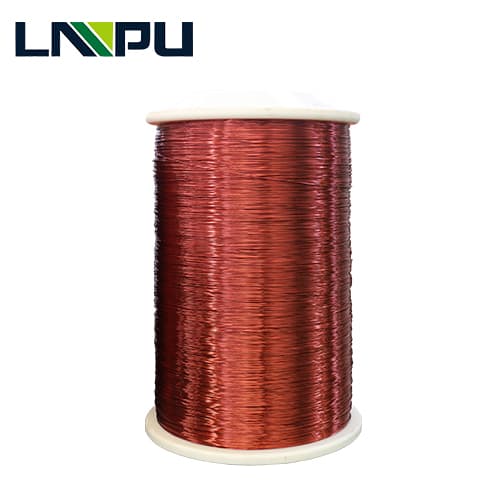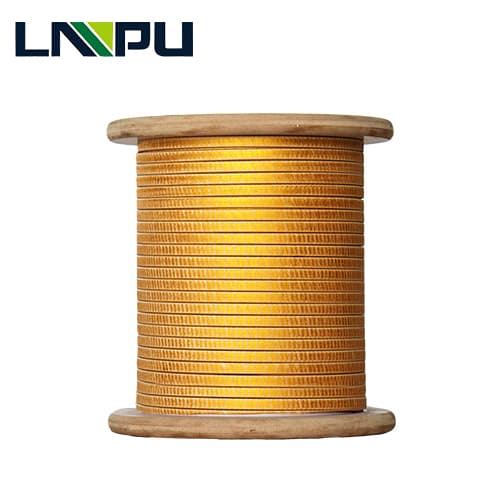
What Is Enameled Copper Clad Aluminum Wire?
Enameld Copper Clad Aluminum Wire (Enameld CCA Wire) is a compound winding conductor of aluminum core, bonded-on copper layer, and the enamel insulating layer.
Aluminum core is supporting the lightweight conducting material and copper cladding appears as a shroud around the aluminum core as a conducting surface. A layer of enamel is covered and used to electrically insulating the conductor as winding.
Enameled CCA Wire Construction
The basic construction is:
Enamel Insulation → Copper Cladding → Aluminum Core
Aluminum Core
The aluminum core provides the lightweight body of the conductor and contributes to overall weight reduction.
Copper Cladding
A continuous copper layer is bonded around the aluminum core. Copper cladding ratio can be specified according to the application and technical requirements.
Enamel Insulation
The external enamel coating electrically separates adjacent turns and protects the conductor during winding and operation.
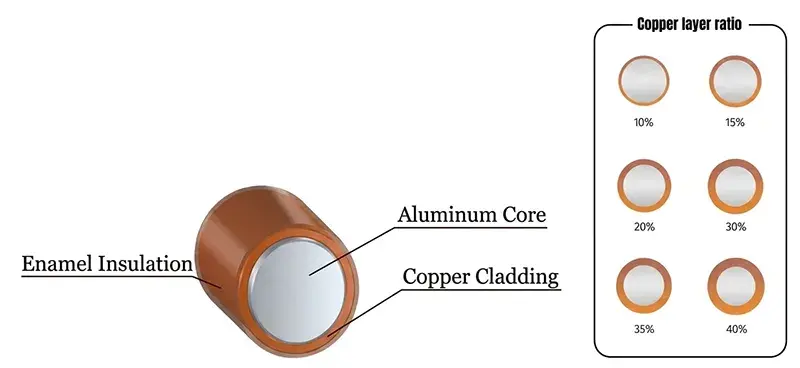
From an enameled copper wire, Enameled CCA Wire can decrease the weight of the conductor. From enameled aluminum wire, it can offer a copper-clad conductor surface.
Therefore, CCA wire should not be regarded as a substitute for solid copper wire of equal conductor diameter. Electrical resistance, current density, thermal performance, winding space and connection criteria should all be taken into consideration when choosing the conductor.
ECCAW Technical Specificaitons
| Enameled Type | Polyester or Solderable Polyurethane | Modified Polyester or Solderable Polyurethane | polyester-imide Or Solderable Polyurethane | Polyamide-imide | polyester-imide /Polyamide-imide |
| Products type | PEW/130 UEW/130 | PEW/155 UEW/155 | EIW/180 UEW/180 | EIW/AIW/200 | EIW(EI/AIW)/220 |
| Temp Class | 130 | 155 | 180 | 200 | 220 |
| Insulation Grade | Grade1/Grade2/ Grade3 | Grade1/Grade2/ Grade3 | Grade1/Grade2/ Grade3 | Grade1/Grade2/ Grade3 | Grade1/Grade2/ Grade3 |
| Standard | IEC,NEMA,JIS,GB or according to customers’ requirements | ||||
Why Choose Enameled Copper Clad Aluminum Wire?
Significant Cost and Yield Advantages
The density of aluminum (~2.7 g/cm³) is only about 30% that of copper (~8.89 g/cm³). For the same wire gauge, the length of copper-clad aluminum wire of equal weight is approximately 2.5 to 2.7 times that of pure copper wire. Since enameled wire is typically purchased by weight and processed into windings by length, using ECCA can significantly reduce the raw material procurement cost per unit.
Ultimate Lightweight Properties
The specific gravity of copper-clad aluminum ranges from approximately 3.32 to 3.63 g/cm³ (depending on the volume ratio of the copper layer—10% or 15%), which is only 37% to 40% that of pure copper wire. For audio speaker voice coils, micro-motors, portable transformers, and model aircraft equipment, it effectively reduces the weight and moment of inertia of the devices.
Superior Electrical Performance Under High-Frequency Skin Effect
Under high-frequency signals or currents, the skin effect causes current to concentrate and flow along the surface of the conductor. Since ECCA has a pure copper outer layer, its AC impedance and electrical conductivity at high frequencies are extremely close to those of pure copper wire, making it ideal for high-frequency transformers, inductors, and audio equipment.
Superior Solderability and Connection Reliability Compared to Pure Enameled Aluminum Wire
Pure aluminum wire is prone to oxidation and is difficult to solder conventionally, whereas ECCA’s copper outer layer retains the solderability of pure copper wire. It can be directly soldered with standard tin or crimped to terminal connectors, avoiding the problems of electrochemical corrosion and poor contact associated with aluminum terminals.
Good Suitability for Winding Applications
Copper-clad aluminum wire has moderate tensile strength and yield point. It exhibits less springback during winding than pure copper wire and has good elongation, resulting in minimal wear on the tension mechanisms of winding equipment and helping to improve the flatness of coil assemblies.
ECCA vs Enameled Copper wire VS Enameled Aluminum Wire
| Performance Specifications | Pure Enameled Copper Wire (ECU) | Enameled Copper-Clad Aluminum Wire (ECCA-10/15%) | Pure enameled aluminum wire (Eal) |
| Density (g/cm³) | ~8.89 | ~3.32 – 3.63 | ~2.70 |
| DC Resistance (Relative Value) | 100% (reference) | Approximately 1.45–1.60 times that of copper wire | Approximately 1.68 times that of copper wire |
| High-frequency AC resistance | Reference | Close to pure copper wire | Poor |
| Soldering and terminal connections | Excellent | Good (tin adheres directly to the copper layer) | Poor (requires special flux/lead) |
| Weight-to-Volume Ratio | 100% | ~37% – 40% | ~30% |
| Length-to-weight ratio | 1 (Reference) | ~2.5 – 2.7 | ~3.3 |
Enameled Copper Clad Aluminum Wire Application:
Due to its DC resistance being slightly higher than that of pure copper, it is best suited for applications prioritizing high-frequency performance, lightweight design, and cost-effectiveness, such as
1.Special magnet wire applied in voice coils, CD-ROM coils;
2.Light ECCAW magnet wire for mobiles and watches;
3.Magnet wire for high frequency transformers;
4.Magnet wire for deflexion coils of display;
5.Magnet wire for degaussing coils of display.
ECCA does not entirely replace copper wire; for heavy-duty motors or power-frequency transformers with stringent requirements regarding slot fill factor and low DC heat generation, pure copper wire remains the preferred choice.
Enameled Insulation for CCA Winding Wire
The insulation varnish coating systems for enameled copper-clad aluminum wire (ECCA) are primarily classified and specified in accordance with standards such as IEC 60317, NEMA MW 1000, and GB/T 6109 / GB/T 26071. The selection of the insulation varnish directly determines the wire’s temperature rating, dielectric strength, solderability, and mechanical strength during processing.
| Insulation Material | Abbreviation | Temperature Rating (Thermal Class) | Key Characteristics and Applications | Corresponding International/National Standards |
| Polyurethane | UEW / QA | 130°C (Class B) / 155°C (Class F) / 180°C (Class H) | Excellent direct solderability (direct tinning at 370–400°C without stripping the solder mask); suitable for high-frequency inductors, voice coils, and micro-motors | IEC 60317-20 / NEMA MW 75-C |
| Polyester | PEW / QZ | 130°C (Class B) / 155°C (Class F) | Good basic heat resistance and low cost; suitable for conventional power-frequency transformers and electronic coils | IEC 60317-3 / NEMA MW 5-C |
| Polyesterimide | EIW / QZY | 180°C (Class H) | Good thermal shock resistance and excellent solvent resistance; widely used in motors and dry-type transformers | IEC 60317-0-13 / NEMA MW 30-C |
| Polyesterimide + Polyamideimide (Composite Double Coating) | EI/AIW / QZY/XY | 200°C (Class N) / 220°C (Class C) | EIW base layer + PAI top layer, combining high heat resistance, refrigerant resistance, and high scratch and abrasion resistance; used in equipment with high overload requirements | IEC 60317-13 / NEMA MW 35-C |
| Polyamideimide / Polyimide (Polyimide) | AIW / PIW / QY | 220°C ~ 240°C | Extremely high temperature and radiation resistance; used in aerospace applications and special-purpose motors operating at ultra-high temperatures | IEC 60317-46 / NEMA MW 16-C |
Coating Structure and Thickness Grade Specifications (Insulation Grade / Build)
According to the IEC 60317-0-1 and NEMA MW 1000 standards, paint film thickness is classified into the following grades, which directly affect breakdown voltage and slot fill rate:
- Grade 1 (Single Build / Grade 1 Paint Film): The paint film is relatively thin, with a high slot fill rate, making it suitable for winding small coils in space-constrained applications.
- Grade 2 (Heavy Build / Grade 2 Paint Film): A thicker paint film that provides higher breakdown voltage and resistance to mechanical scratching; this is the standard configuration for industrial transformers and motors.
- Self-Bonding Outer Layer (SB): A layer of thermoplastic or thermosetting self-bonding varnish (such as thermoplastic polyamide or PVB) is applied over the primer; after heating or the addition of a solvent, the coil cures and takes shape on its own, eliminating the need for subsequent varnish impregnation.
Standard Test Method for Insulating Varnishes for CCA (IEC 60851)
Since copper-clad aluminum wire features a copper-aluminum bimetallic interface, the insulation system must undergo rigorous testing of the following physical and electrical properties:
- Adhesion and Elongation: In accordance with IEC 60851-3, a sudden pull-off test and a winding test are conducted to ensure that no delamination occurs between the varnish film and the copper layer, or between the copper layer and the aluminum core, during high-speed winding.
- Thermal Shock Test: After the test specimen is stretched or wound onto a specified mandrel, it is placed in a high-temperature oven (e.g., 200°C for 30 minutes) to check for cracking in the varnish film.
- Dielectric Breakdown Voltage: Tested in accordance with IEC 60851-5 procedures (using the twisted-pair method or steel ball method for round wires) to ensure no breakdown due to micro-pores.
- Solderability Test: For UEW-CCA conductors, the time required for the paint film to automatically release the tin and allow the conductor to be wetted and coated with tin in a 375°C ± 5°C tin bath is tested (typically less than 2 seconds for small wire diameters).
ECCA Winding Wire FAQs: Specs, Standards, Customization & Replacement Guide
A: Enameled Copper Clad Aluminum Wire (ECCA) is a composite winding conductor consisting of an aluminum core, a metallurgically bonded outer copper cladding, and a protective enamel insulation layer. It combines the excellent high-frequency conductivity of copper with the light weight and cost-efficiency of aluminum.
A: Yes. ECCA has a density of approximately 3.32 g/cm³ to 3.63 g/cm³, which is only 37% to 40% the weight of solid copper wire. This significant weight reduction lowers shipping costs, reduces equipment weight, and decreases rotational inertia in dynamic applications like speaker voice coils and micro-motors.
A: No. Enameled aluminum wire consists entirely of an aluminum conductor, whereas ECCA wire features a bimetallic structure with an aluminum core surrounded by a bonded copper skin. The copper outer layer provides significantly better direct solderability, lower contact resistance, and superior high-frequency AC electrical performance compared to pure aluminum.
A: ECCA can replace copper wire in many electrical and electromagnetic applications, but it is not always a 1:1 direct swap at the exact same conductor diameter. Because ECCA has higher DC resistance than copper (~1.45–1.60x), engineers typically need to increase the conductor cross-section by 1 to 2 AWG/SWG sizes to achieve equivalent DC resistance and thermal performance.
A: Yes. When insulated with Polyurethane (UEW/QA coating), ECCA wire supports direct solderability at soldering temperatures of 370°C to 400°C without mechanical or chemical enamel stripping, enabling rapid assembly on automatic pin-soldering machines.
A: Due to the lower density and raw material cost of aluminum, 1 kg of ECCA provides approximately 2.5 to 2.7 times the winding length of 1 kg of pure copper wire. Replacing pure copper wire with ECCA typically reduces overall winding material costs by 30% to 50%, depending on current copper market pricing and wire gauge.
A: Standard industry offerings include 10% (CCA-10) and 15% (CCA-15) copper volume ratios. CCA-10 is the most popular choice for general transformers and motors due to optimal cost performance, while CCA-15 offers lower DC resistance for applications demanding higher conductivity.
A: The base bimetallic conductor complies with ASTM B566 specifications. The enamel insulation system and testing methods conform to IEC 60317 series (e.g., IEC 60317-20 for UEW, IEC 60317-13 for EI/AIW) or NEMA MW 1000 standards depending on destination market requirements.
A: ECCA wire is widely used in high-frequency switching transformers, television degaussing coils, loudspeaker voice coils, choke coils, network inductors, small household appliance motors, and automobile micro-motors where weight savings, cost reduction, or skin-effect conductivity are critical.
A: We supply ECCA wire on standard plastic spools including PT-4, PT-10, PT-15, PT-25, and DIN series (e.g., DIN 160, DIN 200, DIN 250). All spools are vacuum-wrapped and packed in heavy-duty export cartons or wooden crates suitable for high-speed automatic winding processes and long-distance ocean transport.
A: Yes. Custom wire diameters (from fine wire to heavy gauge), non-standard copper volume ratios, specific enamel coating thicknesses (Grade 1 / Grade 2 / Heavy Build), thermal classes (130°C to 220°C), and self-bonding outer coatings (SB) can be customized upon technical evaluation.
A: Yes, sample spools are available for engineering evaluation and winding trials. Please provide your required wire diameter, insulation type, thermal class, and application details so we can dispatch the exact specification for testing.
A: To receive a precise quote within 24 hours, please specify:
Conductor size (mm, AWG, or SWG)
Copper ratio (CCA-10% or CCA-15%)
Enamel type & Thermal class (e.g., UEW 155°C, EI/AIW 200°C)
Insulation build (Grade 1 or Grade 2)
Spool size and total target quantity (kg)