
What Is Enameled Wire for New Energy Vehicles?
Customized enameled wire for electric vehicle- enameled wire electric vehicles also called EV magnet wire/ for new energy vehicles winding wire, Electric vehicles enameled wire is a kind of Electric motor in vital parts of new energy vehicles (NEVs), itself ends of electric vehicle (battery EVs, PHEV, hybrid, etc. An important components.)
Definition of EV Magnet Wire
EV magnet wire (or electric vehicle enameled wire) is a conductor of high purity copper (or a conducting element, like aluminum), which is insulated with a very thin, long lasting polymer-based insulation, generally computer-enamel, which is made of polyester, polyamide-imide, polyimide etc.
This has a very high resistance (10-8-10-5 ohm/cm at 20°C) to allow the wiring to be tightly wound up in coils used for the electromagnetic field (mainly traction motors) without any potential for a short circuit between turns of wire. It is a very fine coating, usually just micrometers thick, to save the area used for the conducting material for power density reasons.
EV-grade types are developed to endure the extreme conditions of automotive environments (high temperatures, (usually Class 180 degreesC to 220 degreesC or more), voltage transients from inverters, vibration-mechanical, long-term reliability in aggressive environments).
Why New Energy Vehicles Require High-Performance Magnet Wire
New energy vehicles (NEV), especially electric vehicles (EV), are highly dependent on advanced electric motors. The strong, high-efficient electric motor which is an essential component of EV is driven by great quantity of high-performance magnet wire (also called enameled wire for EV or EV magnet wire). High-performance magnet wire is adapted to fulfill the demanding requirements of today s EV powertrain unlike traditional winding wires.
Higher Operating Temperatures and Thermal Stress
Electric vehicle (EV) traction motors dissipate large amounts of heat due to high power densities, regenerative braking and high acceleration rates. The motors will typically run at elevated temperatures with some hotspots above 150–200 degreesC.
Typical magnet wire will overheat or fail when operated in such environments. This can result in reduced life or the complete failure of the motor. High performance EV magnet wire utilizes modern insulations (for example polyimide or polyamide-imide enamels) that are rated at a Class 200 degreeC or more. This allows a safe margin for long lifetime operation and ensures no breakdown of motor insulation.
High-Voltage Architectures and Inverter Challenges
Current EVs are moving toward 800 V architecture for faster charging and enhanced efficiency. This architecture allows for high-voltage transients and high-frequency PWM signals from inverters.
Normal wire insulation is prone to partial discharge and corona effects degrading the insulation over time. High performance magnet wire has much higher dielectric strength and a corona-resistant coating which reduces the chance of shorts and helps extend the life of the winding.
Demand for Higher Efficiency and Power Density
Efficiency is key for EV range and performance. Each percentage improvement in motor efficiency results in increased driving range and reduced battery sizes. High efficiency magnet wire allows this by:
Flat or rectangular wire design: Increase the slot fill factor (more copper in the same area) compared to round wire, decreased resistance and copper losses.
Thinner yet still very strong insulating layers with a larger conductor volume.
High thermal conductivity to enhance heat dissipation in the compact hair pin or wave-wound stators.
Resulting in motors that reach efficiencies of 93–97% or greater.
Mechanical Durability and Harsh Automotive Environment
The life of the electric vehicle winding wire is a very important consideration as it will be continually vibrated, traversed by heat cycles, packed with moisture and coated in automotive fluids. The high power, new energy vehicle winding wire is required to have better mechanical strength, improved flexibility to suit automated winding, and good chemical resistance to reduce abrasion or cracking of the insulation during manufacture as well as over the 10–15+ lifespan of the vehicle.
Safety, Reliability, and Regulatory Compliance
A motor failure in an EV can result in a loss of propulsion, safety concerns and / or a costly recall. Good quality, premium magnet wire exceeds automotive requirements in terms of insulation integrity and reliability. It also enables the overall aim of lowering the weight of the vehicle while maximizing energy efficiency to be achieved in support of international sustainability targets.
Main Applications of Enameled Wire in New Energy Vehicles
EV Traction Motors
The biggest and most intensive use of an enameled wire in NEV is in traction motors, which are used in delivering mechanical energy from electrical input.
Hairpin Motors: state-of-the-art high-efficiency traction motors employ hairpin winding technology. Our rectangular traction motor magnet wire enables tight, accurate windings with great slot fill factors to minimize resistance while increasing the power density. Our durable insulation is capable of withstanding the forces of automated hair pin insertion as well as the elevated operating temperature.
Stator Windings: the stator is the motor stack which sits stationary and contains most of the EV motor winding wire. High performance enameled wire allows tightly packed, multi-layere winding capable of providing maximum electromagnetic performance and efficient heat dissipation.
Rotor Windings: Some motors (wound-rotor synchronous motors), use magnet wire on the rotor as well, for improved torque and efficiency over a broad speed range.
They also need to have wire that has better corona resistance, high thermal classoften 180220 degreesC)), and good dielectric properties so they can handle the traveling voltage spike from the inverter.
Onboard Chargers (OBC)
Chargers onboard change AC power from public charging points into Dc for the battery. They use transformer and inductor which are manufactured withpecial OBC magnet wire and charger transformer wire.
Enameled wire in these high frequency transformers must facilitate small size, high power conversion efficiency and acceptability of thermal loads. Thin, high-temperature insulation reduces the size and weight and still safe and efficient during fast-charging.
DC-DC Converters
DC-DC converters, which DC-boost or buck between the high-voltage battery pack and a lower-voltage systems (such as the 12V auxiliaries). They use high-frequency transformers and inductors wound with enameled wire designed for high frequency switching.
The use of EV magnet wire throughout these components will help to keep the losses low, provide good thermal characteristics and may even help to keep electrical noise down within the vehicle.
Battery Management Systems (BMS)
The BMS keeps track of and controls of the health, safety and performance of the battery pack. Smaller but similar that;
Sensors: Needed for basic measurements such as temperature, voltage, and current.
Miniature transformers and isolation components.
Relays: In applications where dependable coil windings are essential for switching functions.
Excellent insulation would also ensure that the electrical isolation and stability of the battery over a long period is maintained in this difficult thermal and vibration environment.
Charging Piles (EV Charging Stations)
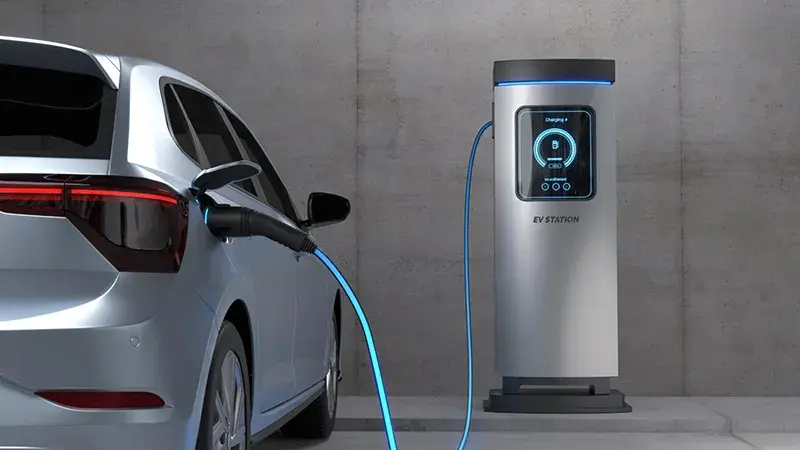
Charging infrastructure also relies on enameled wire. Charging station transformer wire can be found in power transformers, filters and converters of AC and DC fast-charging piles. These applications require wire of high currents conduction, good insulation (to be used outdoor or on high-power racks) and efficiency (to reduce energy losses when charging).
Auxiliary Motors
In addition to the main traction motor, the NEV has several other smaller electric motors. They use specialized magnet wire for small size, smooth, quiet operation:
Cooling pumps: For thermal management of the motor and batteries.
HVAC cabin compressor: HVAC Pumps and Compressors provide cabin climate control.
EPS (Electric Power Steering) motors: In need for accurate support when steering. Blowers made by fans and other.
The use of enameled wire in these systems allows for the high power density to be achieved within a small package under a steady state or intermittent duty cycle.
Types of Enameled Wire Used in EV Applications
Magnet wire for new energy vehicles (NEVs) is an enameled wire. For the enameling wire, various types are used according to its temperature resistance, insulating resistance, mechanical strength and according to application – e.g. Efficiency, power density, light weight… In new energy cars for EV magnet wire, and winding wire for new energy vehicles, high standard characteristics are extremely necessary because of the difficult working environment of traction engine, charger and auxiliary system.
Key Types of Enameled Wire for EVs
Here is a comparison of common types used in EV applications:
| Wire Type | Temperature Class | Typical Applications | Key Characteristics |
| Polyester | 155°C | Auxiliary motors (fans, pumps) | Cost-effective, good baseline thermal and mechanical properties for lower-demand applications. |
| PEI (Polyetherimide) | 180°C | Industrial motors, some auxiliary EV systems | Balanced performance with good chemical resistance and thermal stability. |
| PEI + PAI | 200°C | EV traction motors | Excellent thermal endurance, corona resistance, and suitability for inverter-driven systems. |
| PAI + PI | 220°C | High-end EV motors | Superior high-temperature performance, outstanding dielectric strength for extreme conditions. |
| Rectangular Copper Wire | 200–220°C | Hairpin motors (stator windings) | High slot fill factor, improved efficiency and power density; ideal for compact, high-performance designs. |
| Flat Aluminum Wire | 200°C | Lightweight EV motors | Lower weight and cost compared to copper; good conductivity-to-weight ratio for specific applications. |
Notes on the Table:
Temperature class –class of temperature where the maximum continuous operating temperature the insulation can reliably sustain is indicated.
The mixtures such as PEI+PAI or PAI+PI once again imply a multi-layer package, preparing even higher qualities.
Both shape configuration and shape variants exist. Rectangular and flat shaped wire are shape variants that makes use of the types of insulations above, optimised for certain winding configurations.
Detailed Overview of Each Type Enameled Wire
Key Performance Requirements of Enameled Wire for New Energy Vehicles
Thermal Resistance
Thermal endurance is another major criteria. With EV traction motors and power electronics capable of producing high heat, the insulations must be of high temperature class.
155 °C: Adequate for supplementary motors (fans, pumps) with medium loads.
180 °C: Often used to describe general auxiliary systems and some lower-power equipment.
200 °C: Most common temperature in mainstream EV traction motors; supports many continuous high load operation.
220 °C [High-end and premium motors]: Support the most demanding needs of high-end and high performance motors. Extreme conditions, fast charging and longest lifetime.
Higher thermal classes, often achieved with PEI, PAI or PI based enamels, protect the insulation from deterioration, preserve the dielectric characteristics and prolong the motor life span.
Partial Discharge Resistance
Inverter driven motors in electric vehicles generate high d V/dt voltage transients which lead to partial discharges within the winding (electrical sparks inside air pockets or voids in the insulation). These remove enamel over the duration leading to lead to deterioration of the insulation and a motor failure. EHV enameled wire is formulated with coatings that resist partial discharge over the life of the motor.
Corona Resistance
Corona discharge takes place at high voltages and can predispose the failure of the insulation. EV magnet wire, particularly at 800V is fitted with multi-layer corona-resistant enamels to prevent this occurring. It is important for efficiency reasons and to prevent arcing in compact high voltage windings.
High Dielectric Strength
The insulation must be able to operate at very high voltages without breaking down. Electric vehicle applications require superior dielectric strength to deal with transient voltage spikes and surges, in addition to continuous high potential differences between winding turns. We need thinner, although more robust insulation layers to make the most of copper fill.
Flexibility
Throughout manufacturing, electrical wires are subjected to automated winding, hairpin forming and assembly stresses. Very good flexibility ensures that the coating will not crack or become damaged by the electrical wires. Good flexibility also ensures some leeway for thermal expansion and vibrations of the vehicle during the operational life of the products
Chemical Resistance
The EV motor is exposed to automotive fluids (e.g. Coolants, oils, fuels), water (humidity) and other contamination. The insulation must withstand chemical attack, so that its electrical properties remain unchanged during 10–15 years of operation of a vehicle or more.
Excellent Adhesion
High level of adhesion between the copper (or aluminum) conductor and the enamel is a must. Otherwise, the coating may delaminate under thermal cycling, mechanical strains or winding operations, and weak spots will occur resulting in shorts or compromised performance.
Enameled Copper Wire vs Enameled Aluminum Wire for New Energy Vehicles
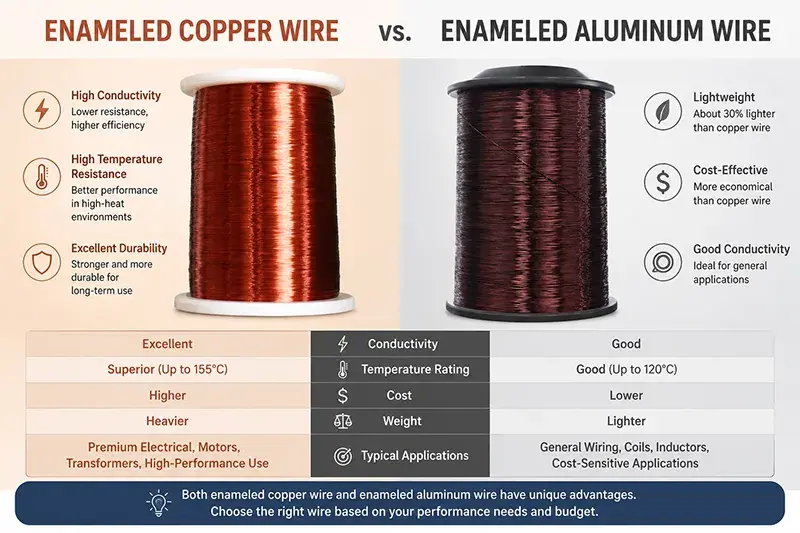
For New Energy Vehicles (NEV), whether to use enameled copper wire or enameled aluminum wire has a profound influence on the performance, efficiency, weight, price and vehicle structure of motors. Both are EV magnet wire or new energy vehicle winding wire, but they have many dissimilarity, such as electrical conductivity, specific gravity, thermophysical property and appliance, etc.
Copper vs Aluminum Enameled Wire: Comparison
| Property | Enameled Copper Wire | Enameled Aluminum Wire |
| Electrical Conductivity | ★★★★★ Excellent | ★★★★ Good (approximately 61% of copper) |
| Weight | Heavy | About 50% lighter than copper |
| Cost | Higher | Lower |
| Mechanical Strength | Excellent | Moderate |
| Flexibility | Excellent | Good |
| Thermal Conductivity | Excellent | Good |
| Corrosion Resistance | Excellent | Good with proper insulation |
| Current Carrying Capacity | Higher | Requires larger cross-section |
| Winding Size | More compact | Larger conductor required |
| Typical Service Life | Very long | Long with proper design |
| Recycling Value | Higher | Moderate |
Electrical Conductivity
Where IACS is equal to 100% for copper and 61% for aluminum. In order to use aluminum as the same conducting cross sectional area of the copper you need to use a larger cross sectional area for aluminum, by approximately a factor of 1.6.. For example a 1.00mm2 copper performing conductor may be replaced with an approx. 1. 6mm2 aluminum performance conductor. Hence the reason for copper being used in high efficiency motors and small transformers whereas aluminum is used for applications where weight is critical.
Weight Comparison
Another primary benefit of aluminum is its significantly lower density (2.70 g/cm3, as opposed to 8.96 g/cm3 for copper). Despite larger conductor cross-sectional areas needed to overcome the metal‘s lower conductivity, aluminum windings are generally 40–50 % lighter than an equivalent copper winding (improving the range, handling and efficiency of electric vehicles).
Cost Comparison
Prices for copper vary considerably and are normally many times the price of aluminum wire. Enameled aluminum wire has lower material cost, lower freight cost (lighter weight) and better overall cost/performance ratio, when produced in very large quantities. For low-cost EV programs, aluminum may be used to cut winding costs by large amounts while still meeting the desired performance to a reasonable degree when properly designed.
Mechanical Strength
Copper has much better mechanical properties (it has higher tensile strength, better resistance to repeated bending, less chance of damaging, and easy to feed automatically during manufacture of motor for electric vehicles). Aluminum is soft, and must be treated more carefully during manufacture, though modern aluminum alloys have much improved strength compared to old aluminum wire.
Thermal Performance
The emalled copper wire and the emalled aluminum wire can perform well at a high temperature as long as they are used together with excellent enamel insulas. Typical heat classes available now are Class F (155 degreesC), Class H (180 degreesC), Class N (200 degreesC) and Class R (220 degreesC). In the end, it is the insulation system that determines what kind of thermal grades the wire can reach, not the conductor.
Efficiency and Energy Loss
Lower electrical resistance of copper provides to lower power loss, greater motor efficiency, lower heat generation, and improved longterm energy efficiency. If aluminum is used the cross-section has to be increased in order to obtain the same performances and offers benefits in mass and cost.
Advantages of Enameled Copper Wire in EVs
Except for the most high-performance EV traction motors, enameled copper wire is still the most widely adopted construction because of its higher conductivity, which is:
Lower I2R losses and higher motor efficiency (important for range).
Improves the performance of compact hair pin windings, where high slot fill and low resistance are required.
Impressive thermal performance, with speed able to dissipate heat in high-powered density motors.
Best mechanical characteristics for automated winding process and long-term vibration resistance.
In the case of more premium and high end EVs where maximum efficiency and power delivery are much more desirable and paramount, copper is used.
Advantages of Enameled Aluminum Wire in EVs
There are good reasons to choose enameled aluminum wire, especially in applications where weight or cost is a concern:
Mass reduction you will always need to lower the weight of the vehicle. This is the only way to improve efficiency and range of the vehicle.
Reduced material cost: Assists manufacturers with battery and vehicle pricing.
Satisfactory operation of auxiliary motors (cooling pumps, HVAC compressors, fans) and some main traction motors (economy models).
The development of flat/rectangular aluminum wire combined with better insulation materials has increased its suitability for application in small, light weight EVs.
Manufacturing Standards & Certifications of Enameled Wire in EVs
The high quality enameled wire (EV magnet wire or new energy vehicle winding wire) is produced with use of strict international and industrial standards to ensure safe, reliable and efficient operation in electric vehicles with high electrical and mechanical efficiency. The manufacturers conduct detailed testing procedures as follows.
Key International Standards
IEC 60317: Established worldwide as the most common standard for magnet wire information. States shape dimensions and insulation classifications, possible thermal classifications (i. E. 155 degreesC to 240 degreesC) and the test procedures for enameled round and rectangular wire.
NEMA MW 1000: North American Standard for magnet wire different types of wire are designed for a variety of characteristics.
JIS C 3202 / JIS C 3216: Japanese Industrial Standards8 frequently encountered in Asian EV supply chains.
GB/T 6109 (China): ENAMELED WIRE : (the world’s largest EV market). As the largest EV market in the world, China determines the specification of enameled wire as a whole.
Learn More Technical Parameters of Enameled Wire, visit Technical Values of Magnet Round Wires
Automotive Industry Certifications
EV applications often require additional qualifications beyond general magnet wire standards:
The International automotive task force (IATF) 16949. The automaker‘s quality management system standard – Suppliers of EV magnet wire are required to adhere to the parameters established in the standard to satisfy OEM quality standards (traceability, process control and prevention of defect)
UL Certification: Underwriters Laboratories standards (e.g. UL 1446) for electrical insulation systems. It guarantees that the component is safe to use in environments where there will be high voltages.
VDE / TUV Approvals: Widely used within European markets for electrical safety and environmental compliance.
ISO 9001 / ISO 14001: Simple accreditation for quality and environmental management.
Specific Performance Tests for EV Wire
Certified enameled wire undergoes extensive testing, including:
Blast, thermal resistance and shock tests
Dielectric breakdown voltage
Partial discharge and corona resistance
Abrasion test, bend test, and glue test;
Chemical resistance to automotive fluids
Dimensional tolerances (especially rectangular wire for hairpin)
How to Select the Right Enameled Wire for New Energy Vehicles?
A traction motor is arguably the most important component of an NEV drivetrain. It is crucial to decide what type of enameled wire you will use for the windings of traction motors, because it directly affects the motor‘s performance, reliability and product cost. Choosing the best enameled wire is a typical engineering trade-off because enameled wire properties are a compromise of fields such as heat, mechanical stress, and chemical attacks.
Key Performance Requirements
“Compared to standard industrial motors NEV drive systems are subject to much more rugged parameters than for standard applications, there is a large focus on”
Thermal Class: NEV motors can run very high power levels and temperatures. Typical insulation completely breaks down at this level. In general you‘ll need to run the appropriate wire for the applicable Class H (180), or Class C (200 – 220).
Partial Discharge Resistance Modern NEVs employs high-voltage configurations at (>800V) with Silicon Carbide (Si C) inverters which produce electrical pulses high-frequency and rapid rise which may induce partial discharge (electric erosion) of the insulation.
Mechanical Integrity: The windings (particularly in hairpin or rectangular winding arrangements) will be subjected to large forces. The insulation coating of the wire must be flexible enough not to crack when bent/ inserted, but not too soft, as to damage when subject to abrasion.
Chemical Compatibility: Cannot be chemically affected or swelled by the cooling agent (oil, water-glycol) or impregnating resins used in the motor housing.
Choosing the Right Materials
Insulation Systems
The choice of polymer determines the wire‘s durability:
Polyester/Polyesterimide: General purpose, also provides lower water absorption and good stability in the presence of oils/greases. Often inadequate for high voltage NEV applications.
Polyamide-imide (PAI): The current industry leader for high performance applications. It is thermally-stable and mechanically-tough.
Polyimide (PI): used for the most demanding applications. While it provides the best thermal resistance, it can be more expensive and more difficult to process.
Conductor Shape
Round Wire: easy to wind, cheap and old school. It also has a low “slot fill factor” so less copper can occupy the same space and hence has a low power density.
Rectangular/Hairpin Wire: The best available for any modern NEV traction motors. This also offers a much higher slot fill factor increasing both efficiency and thermal dissipation.
Critical Selection Criteria (Checklist)
When evaluating a supplier or a specific wire grade, verify the following:
| Feature | Requirement for NEVs |
| Voltage Withstand | Must exceed the peak voltage of the inverter (e.g., 1200V+ for 800V systems). |
| dv/dt Immunity | Resistance to corona/partial discharge degradation from SiC inverters. |
| Bonding Capability | If using “self-bonding” wire, ensure the adhesive layer melts and sets correctly during the lamination process. |
| Flexibility | Ability to withstand the “hairpin” bending process without enamel cracking. |
Why LP Industry Is Your Trusted EV Magnet Wire Supplier
Over 30years manufacturing experience has made LP Industry into a trusted suppliers of high-quality, high performance enameled wire for the new energy vehicles Industries. We can produce the enameled wire in custom sizes, multiple kinds of insulation system (High-temperature PEI, PAI, PI, and others.) OEM/ODM support available to meet all sorts of EV motor and component needs. Our rigorous quality inspection process, global export experience, and world-wide delivery experience guarantee their quality remain good and on-time delivery to worldwide customers.
LP Industry recognizes the brisk pace of the EV industry so we offer fast sampling, small MOQ available and flexible production solution. LP Industry is your reliable partner in providing customized high quality EV magnet wire which alleviates your weight issue (rectangular copper wire for hair pin traction motor or lightweight aluminum for auxiliary system), and enhance the efficiency, reliability and economy of your EV project.
Frequently Asked Questions
Can enameled aluminum wire be used in EV motors?
Yes. Enameled aluminum wire is feasible for some EV motor types. It is advantageous for an auxiliary type EV motor, a light-weight traction motor design, or any case where keeping weight and material cost down is a top factor. Enameled aluminum wire has a somewhat inferior electrical performance to copper wire, but by increasing the cross-sectional area of the wire, an equal electrical performance can be reached. Today‘s high temperature insulated enameled aluminum wire has excellent thermal stability and durability.
What insulation class is recommended for electric vehicles?
Over 95% of the electric drive motors will need enameled wire with Class N (200°C) or Class R (220°C) rated insulation, since they will be operating at elevated temperature, powered by inverters (high voltage/voltage spike) and have often aggressive duty cycles. Similarly, the high end of traction motors (e.g. main motor) will be designed with 220°C rated PAI+PI insulated magnet wire, while auxiliary motors or less aggressive applications will be designed with 180°C and/ or 200°C rated insulation systems, depending on particular systems specifications.
What wire is used in hairpin motors?
In the case of Hairpin motors, the motors are constructed of rectangular or flat enameled copper wire with high-temperature insulation (typically 200 o C or 220 o C). The rectangular conductor allows for a higher fill factor of the motor slots, decreasing the electrical resistance of the conductors as well as allowing dissipation of heat into the motor, thus increasing the efficiency and power density. In some of the lighter weight EV applications, rectangular enameled aluminum wire is used in the same way, as automakers attempt to shed overall vehicle weight without significant performance loss.
What is PD-resistant magnet wire?
PD-resistant (Partial Discharge-resistant) magnet wire has been developed to resist damage by Partial Discharge a phenomenon that can occur at high frequency inverter voltages such as those applied to Electric Vehicle drive systems. PD resistant wire enhancement surpasses the performance of traditional magnet wire for insulation of electric vehicle motors, making it the clear choice for inverter fed EV motors.
What is the lifespan of EV Magnet wire?
Electric Vehicle Magnet Wire Life: The service life of an EV magnet wire is related to operating temperature, winding system, load conditions, and manufacturing quality. A high-quality, enameled wire for electric vehicles is able to operate reliably for 15–20 years, or over 20,000 hours, at normal operating conditions. Use of high-temperature insulation, proper cooling, and high-quality winding processes will ensure a maximum life of the motor and its insulation system.
What is the superior material for higher efficiency EV motors; copper or aluminum?
Not one material is better; they both have their advantages and disadvantages and depending upon the application determines which material is best suited to the task. Enameled Copper wiring has lower resistance, is mechanically stronger and has a more compact winding design than enameled Aluminum; hence are used in traction motors. Enameled Aluminum wiring uses less material, is lighter and can be cheaper than enameled Copper wiring and hence would make a suitable choice in weight sensitive designs, auxiliary or less power demanding uses.
Are you able to manufacture the custom rectangle wire?
Yes. We produce OEM specification wide and flat enameled copper and aluminum wire in custom sizes for motor, transformer, generator, and new energy vehicle manufacturer needs. Customized conductor sizes, insulant thicknesses, thermal classes from 155 degreesC to 220 degreesC, electrical insulation systems such as PEI, PEI+PAI, PAI+PI, and other customized configurations available. OEM and ODM, prototype sample and technical service are provided to assist customers in winding design.