
Introduction
Enameled copper wire, also known as electromagnetic wire, winding wire, is an indispensable core material in the fields of electric motors, transformers, new energy equipment, electronic appliances and rail transport. The electromagnetic induction, energy conversion and safe conductive transmission of all electrical equipment rely on enameled copper wire; from micro-headphone speakers, precision sensors, to new energy vehicle drive motors, wind turbines, high-voltage power transformers, this wire has always assumed the core functions of electromagnetic energy conversion and power transmission, and is the key core material for modern electrical equipment to achieve efficient and stable operation.
In the actual R & D, selection and procurement process, many engineers and procurement staff often face all kinds of selection problems: different wire shape, insulation material, temperature resistance level of enameled copper wire performance differences are great, copper, aluminum, copper-clad aluminum and other conductor materials have their own strengths and weaknesses, how to combine the equipment with the conditions of matching the appropriate wire, balancing the performance, stability and cost of production is the industry’s general focus. For this reason, this paper will be from the basic structure, all categories of classification, core performance, production process, selection logic, application scenarios, material comparison and other dimensions, a comprehensive in-depth analysis of enameled copper wire, for equipment development, selection and procurement, quality upgrading and cost optimization to provide a professional, down-to-earth reference basis.
What Is Enameled Copper Wire?
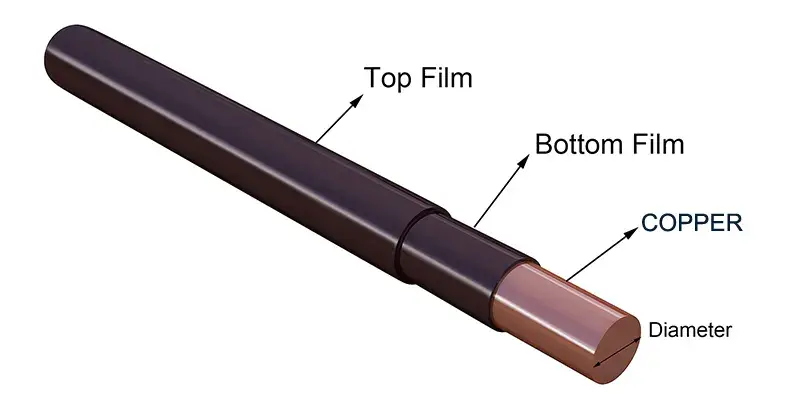
Enameled copper wire is a high-purity electrolytic copper as the conductive core, the outer layer coated with a multi-layer polymer insulating varnish film of special electromagnetic wire, but also various types of electromagnetic winding equipment, the core of the basic materials. Distinguished from ordinary PVC wire and traditional paint wire, its insulation layer for high temperature curing polymer film, with a very thin thickness, high insulation strength, excellent flexibility, suitable for all kinds of precision electrical equipment processing. The overall structure is simple and precise, divided into two core structures: high-purity copper core is responsible for efficient transmission of current, energy conduction, to protect the conductive stability of the equipment; the outer layer of multi-layer thin coating, high-temperature curing process made of composite insulating varnish film, up to a maximum of 30 layers can be superimposed to effectively isolate the current, to prevent short-circuiting between the turns, and at the same time to resist oxidation corrosion and environmental losses, the formation of a thin, uniform and high-toughness of the insulating protection system.
The unique double-layer precision structure gives enameled copper wire an irreplaceable advantage, which can support high-density and tight winding of coils, complete a large number of winding arrangements in a limited space, significantly increase the power density of electrical equipment, and avoid short-circuit faults from the root cause of the coil. Compared with traditional insulating wires, enameled copper wire has outstanding advantages in volume control, heat dissipation performance, conductive efficiency and adaptability to automated processing, which is perfectly suited to the current industry trend of precision, miniaturisation and energy efficiency of electrical equipment, and because of this, it has become an indispensable core winding material for various types of electromagnetic devices such as electric motors, transformers, inductive coils, and precision electronic equipment.
Types of Enameled Copper Wire
Enameled copper wire category is rich, the industry will be based on conductor shape, insulation material, film thickness, temperature rating, conductor material, special features of the six major dimensions of the breakdown, the performance of different categories, the advantages of the adaptability of the scene is very different, accurate differentiation of categories is the basis for selection.
By Shape
The shape of the conductor cross-section directly determines the filling rate, heat dissipation capacity, winding difficulty, mechanical properties and adaptability scenarios of the enameled copper wire, which is the primary consideration in the selection of equipment R & D indicators.
Round Enameled Copper Wire
Round enameled copper wire with a standard round cross-section is currently the largest mass-production scale and the most widely used basic category, with a size ranging from 0.016mm to 6.00mm, and ultra-fine specifications can be as low as 0.01mm or less, which can meet the needs of various types of precision and small-scale equipment.
The core advantages of the product are very prominent: excellent flexibility, suitable for high-speed automated winding equipment, low processing difficulty, high yield; paint film spraying uniformity, the winding process is not easy to break the insulation layer, fall off the problem; complete specifications, strong versatility, low cost. Its only shortcoming is that the filling rate is limited, there is a gap between the wire body after winding, compared with the flat wire will cause 10%-20% copper filling loss, high density coil working conditions, heat dissipation effect and conductive efficiency is slightly inferior.
With high cost performance and versatility, round enameled copper wire is widely used in small and medium-sized motors, conventional distribution transformers, inductors, relays, speakers, precision sensors, guitar pickup coils and other small and medium-sized electrical and electronic equipment, and is the first choice of wire for civil and industrial general-purpose scenarios.
Rectangular (Flat) Enameled Copper Wire
Flat enameled copper wire cross-section is a rectangular structure with rounded corners, the width is greater than the thickness, avoiding the defects of the round wire gap, after winding, like bricks stacked closely, the filling rate can reach 90% -95%, is the core of high-power equipment dedicated wire.
At the performance level, the flat line has significant advantages: the filling rate is greatly increased, the same volume can accommodate more copper, effectively reduce line resistance, reduce heat loss; wire body contact area, heat dissipation efficiency far exceeds the round line, can carry more current, higher power density; can help equipment miniaturisation, lightweight upgrade, to meet the demand for high-end high-power equipment research and development.
Corresponding shortcomings are also more obvious: high hardness of the wire body, poor flexibility, can not be adapted to ordinary winding equipment, the need for special processing equipment; corner position of the insulation layer is easy to break in the processing, production and processing costs are higher.
This category is mainly applied to high-power industrial motors, new energy vehicle traction motors, wind power generator sets, high-voltage power transformers, large-scale reactors, automotive alternators and other high-end industrial and new energy equipment with very high requirements for power, efficiency and heat dissipation.
Square Enameled Copper Wire
Square enameled copper wire is equal in cross-section length and width, and also adopts round corner design, with better filling rate than round wire, and upgraded in structural stability and thermal performance, which is a special category between round wire and flat wire. It has a good balance between filler rate and mechanical strength, better structural stability of the coil, and excellent thermal conductivity.
However, the generality of the wire is extremely low, the production process is complex, high cost, winding difficulty, only applicable to the space is extremely restricted, coil structure requirements of harsh, high-current high-frequency work of the special electromagnetic equipment, mostly used in precision special coils, high-frequency high-power electromagnetic devices, such as niche high-end scenarios.
By Insulation Material
The material of the insulating film is the core factor that determines the temperature resistance level, corrosion resistance, weldability and mechanical strength of the enameled copper wire, and the performance of different polymer materials varies greatly, so matching the material accurately can greatly enhance the service life of the equipment.
Polyurethane (PU)
The first choice for electronic precision scenes, the core advantage is that it can be directly welded, without stripping the insulation layer, the paint film can automatically melt off at a high temperature of 370-430 ℃, processing efficiency is very high, temperature resistance level of 130-180 ℃, suitable for ultra-fine wires and precision electronic equipment, is the mainstream material for consumer electronics, small precision coils.
Polyester (PE)
Cost-effective general-purpose material, balanced mechanical strength and heat resistance, low cost, temperature resistance level 130-155℃, suitable for most of the conventional industrial and civil general-purpose equipment, is the most versatile basic insulation materials.
Polyester Imide (PEI)
Upgraded polyester material, heat resistance is better than ordinary polyester, standard temperature resistance class 180 ℃, cost-effective and outstanding, taking into account the performance and cost, widely used in industrial motors, conventional high-temperature working conditions.
Polyamideimide (PAI)
High-end high-performance materials, with extreme thermal stability, chemical resistance and mechanical strength, often used as the outer layer of composite coatings, temperature resistance level of up to 200 ℃ or more, suitable for high temperature, high load, high corrosion of the harsh working conditions.
Polyimide (PI)
The industry’s top insulation materials, the highest temperature resistance up to 240-250 ℃, while having a strong resistance to radiation, chemical corrosion resistance, designed for aerospace, special military, extreme high temperature and other high-end special scenarios.
Polyvinyl Formal (Formvar/PVF)
Traditional classic material, excellent flexibility and abrasion resistance, temperature resistance level 105-130 ℃, is still widely used in oil-immersed transformers, traditional industrial winding equipment.
In addition, the mainstream of the industry there are double-layer, three-layer composite coating wire, through the polyester base layer + polyamideimide surface layer combination of ways, integration of the advantages of different materials, to achieve heat resistance, abrasion resistance, pressure resistance, corrosion resistance of the comprehensive performance upgrades, mostly used in high-reliability, long-life high-end industrial equipment.
By Insulation Build / Thickness
According to the thickness of the insulating varnish film, the enameled copper wire is divided into three grades, and the thickness directly affects the wire’s pressure-resistant capability and space utilisation, which is a key indicator for the selection of high-voltage equipment.
Grade 1 / Single Build
The thinnest thickness of the enamel film, space filling rate is optimal, the proportion of copper under the same volume is higher, but the breakdown voltage is lower, only suitable for low-voltage, conventional conditions of precision coils.
Grade 2 / Heavy Build
Industry standard thickness, taking into account the pressure resistance and space utilisation, balanced performance, the strongest adaptability, covering more than 80% of the general working conditions, is the mainstream choice in the market.
Grade 3 / Triple or Quad Build
The maximum thickness of the film, insulation and pressure resistance, can effectively resist high-voltage breakdown, transient pulse voltage, high-frequency voltage impact, with excellent insulation stability and anti-aging ability. Sacrifice part of the space filling rate, in exchange for ultra-high electrical safety, specifically for high-voltage transformers, high-power industrial equipment, inverter drive motors and other high-voltage, high-risk conditions, the maximum degree of avoidance of turn-to-turn short-circuit, insulation breakdown failure.
By Temperature Class
Temperature rating is one of the core selection parameters of enameled copper wire, the industry unified ‘thermal classification’ defines the maximum temperature of the wire to continue to work for 20,000 hours without aging failure, which directly determines the service life of the equipment, the ability to withstand high temperatures and the adaptability of the working conditions. Each temperature class corresponds to a clear application scenario, which is the core guarantee for the safe and stable operation of industrial equipment.
| Thermal Class | Working Temperature | Characteristics | Application |
| Class 105 (A) | 105℃ | Low-temperature basic rating, using oil-based paint and formaldehyde insulation, low cost, only supports intermittent low-temperature operation, not resistant to continuous high temperatures. | Suitable for low-power devices such as miniature electronic coils and small precision sensors operating at low temperatures, low loads, and intermittently. |
| Class 130 (B) | 130℃ | General-purpose entry-level temperature rating: Stable performance, high cost-effectiveness, suitable for low-load operation at normal temperatures. | Suitable for general civil transformers, small household appliance motors, conventional relays, and other household electrical appliances and general electronic components. |
| Class 155 (F) | 155℃ | Suitable for general industrial applications: Balanced heat resistance, mechanical properties, and cost-effectiveness; capable of long-term continuous operation. | Suitable for general industrial motors, small and medium-sized water pump motors, general industrial control equipment, and other common industrial applications. |
| Class 180 (H) | 180℃ | High-temperature core grade, excellent heat aging resistance, suitable for complex operating conditions with high temperature, frequent start-stop, and large load fluctuations. | Applications include traditional industrial heavy-duty motors, general automotive motors, and high-end industrial control equipment. |
| Class 200 (N) | 200℃ | High-end high-temperature rating, employing a composite insulation coating, exhibiting outstanding resistance to heat aging and pulse voltage, and extremely strong overall stability. | Suitable for new energy vehicle drive motors, high-end variable frequency motors, high-temperature transformers, energy storage equipment windings, and other new energy industrial equipment. |
| Class 220 (R) | 220℃ | Ultra-high temperature resistance rating, capable of long-term withstand of high temperatures, high vibrations, and complex outdoor conditions, with strong anti-aging and anti-degradation capabilities. | Suitable for special industrial equipment, rail transit traction equipment, and outdoor heavy-duty power equipment. |
| Above 240 (C Class) | 240℃+ | Featuring industry-leading temperature resistance and high-end polyimide insulation, it possesses excellent resistance to high temperatures, radiation, and strong corrosion. | Suitable for high-end and specialized fields such as aerospace, military equipment, deep-sea equipment, and special instruments operating under extreme conditions. |
In the actual selection, the industry’s general golden principle: the selected wire temperature rating than the maximum operating temperature of the equipment needs to be 20-30 ℃ higher than the temperature redundancy, to avoid long-term high-temperature aging caused by insulation cracking, breakdown, and significantly extend the service life of the equipment.
Special Types
For high-frequency, high-temperature, precision moulding, variable frequency impact and other special working conditions, the industry has developed a variety of functional enameled copper wires to solve the process and performance problems that ordinary wires cannot be adapted to.
Self-Adhesive Enameled Wire
The surface layer comes with a special adhesive coating, which can be automatically bonded and cured by heating or solvent activation, without the need for additional winding tape and insulating paint, and can directly fix the coil shape, which is suitable for the mass production of micro-precision coils and skeletonless coils, greatly simplifying the production process and improving the processing efficiency.
Solderable Enameled Wire
It mainly made of polyurethane insulating material, it supports high-temperature direct soldering, no need for manual stripping and mechanical scraping of paint, eliminating the problem of stripping and breaking of fine wires, and it is the core wire for the mass production of precision electronics and miniature coils.
Litz Wire (High Frequency Stranded Enameled Wire)
Stranded from a number of ultra-fine enameled copper wire, a perfect solution to the skin effect under high frequency conditions, reduce high frequency impedance, reduce heat loss, widely used in high frequency transformers, radio frequency coils, high frequency induction equipment.
Corona-Resistant Enameled Wire
Specially developed for inverter motors and inverter drive equipment, it can resist high-frequency pulse voltage, corona corrosion, prevent the insulation layer from being pierced by high-voltage arc, and greatly improve the service life of inverter equipment, and is the special wire for new energy and industrial control inverter equipment.
By Conductor
Conductor material determines the conductive efficiency of the wire, weight, cost, mechanical properties, is a large-scale procurement, equipment cost optimisation of the core considerations, the three mainstream materials have their own adaptive scene.
Pure Copper Enameled Wire
The use of high-purity electrolytic annealed copper core, is the industry standard mainstream material. The core advantages of very high conductivity, low resistance, low heat loss, flexibility, weldability, mechanical strength, thermal stability, excellent all-round, suitable for all high-end, high-efficiency, high-reliability equipment. The only shortcoming is the high density, high material cost, suitable for high performance, life, stability requirements of the motor, high-end transformers, new energy equipment.
Pure Aluminum Enameled Wire
Electric grade aluminium as the core material, the weight is only 1/3 of copper, the material cost is low, and the cost performance is very high. However, the conductivity is only about 60% of copper, the same current demand needs to increase 1.6 times the cross-sectional area, and poor weldability, easy to oxidise, low mechanical strength, only for large static transformers, HVAC equipment, cost-sensitive high-power low-precision equipment.
Copper Clad Aluminum (CCA) Enameled Wire
Aluminium core outer layer of composite metallurgical copper layer, taking into account copper’s weldability, high-frequency conductivity and aluminium’s lightweight, low-cost advantage, performance between copper and aluminium, is the mid-range electronic coils, high-frequency equipment, cost-optimized products, an excellent compromise between the program.
Key Properties of Enameled Copper Wire
Enameled copper wire can monopolise the electromagnetic winding market, replacing the traditional insulating wire, the core from its six irreplaceable hardcore performance, perfectly suited to modern electrical equipment miniaturisation, high efficiency, long-lasting, precision development trend.
First, the ultimate insulation performance, to eliminate electrical failure. Multi-layer polymer high-temperature curing paint film, the thickness of only micron level, but has a strong dielectric strength, can effectively isolate the turn-to-turn current, to prevent coil short-circuit, leakage, breakdown, even if the high-density tightly wound, but also to maintain stable insulation properties, from the source to reduce the probability of electrical failure of the equipment.
Second, ultra-high conductive efficiency, reduce energy loss. The use of 99.99% high-purity electrolytic copper core, conductivity close to the theoretical value, line resistance is extremely low, the working process of I²R heat loss is small, high energy conversion efficiency, can effectively reduce the motor, transformer energy consumption, suitable for energy saving and consumption reduction of the industry demand.
Third, excellent thermal stability, suitable for high and low temperature working conditions. Relying on the graded temperature resistance design, can comfortably cope with -40 ℃ low temperature to 240 ℃ above the high temperature of complex working conditions, long-term high-temperature operation is not easy to aging, cracking, shedding, thermal attenuation is very low, the stability of the equipment operation is greatly improved.
Fourth, excellent mechanical properties, suitable for automated production. The wire is annealed and softened, with excellent flexibility and ductility, wear-resistant and scratch-resistant, anti-stretching, suitable for high-speed automated winding, embedding, bending processing, not easy to break the wire, paint film damage, high yield rate of mass production, suitable for modern intelligent manufacturing production lines.
Fifth, good chemical stability, suitable for complex environments. Insulating paint film can resist conventional solvents, oil, moisture, oxidation corrosion, suitable for oil-immersed transformers, outdoor equipment, humid industrial workshop and other complex working conditions, long-term use is not easy to be corrosion failure.
Sixth, the ultimate space utilisation, help equipment miniaturisation. Compared with ordinary thick insulated wires, enameled copper wire paint film is extremely thin, in the same volume can accommodate more conductive copper, significantly increase the coil filling rate, help equipment lightweight, miniaturisation, high power density upgrade, a perfect fit for new energy, precision electronics product iteration needs.
Manufacturing Process of Enameled Copper Wire
Seemingly simple enameled copper wire, the production process is extremely precise, from raw materials to finished products need to go through nine standardised processes, each step of the process precision directly determines the insulating properties of the wire, conductive stability and service life, but also high-quality manufacturers and poor-quality small factories where the core gap.
The first step, raw material selection. The use of 8mm standard high-purity electrolytic copper rod as the core raw material, strict control of copper purity, to eliminate impurities, oxidation layer, from the source to protect the conductive properties of the wire, low-quality raw materials will directly lead to high wire resistance, serious heat, easy to break the wire and other quality issues.
The second step, multi-stage wire drawing moulding. Coarse copper rod through the multi-stage diamond, tungsten carbide wire drawing die, step by step to reduce the wire diameter, from 8mm thick rod stretching to 0.01mm-6mm different specifications of the finished wire diameter. Multiple progressive drawing process ensures even wire diameter and standard roundness, avoiding the deviation of thickness affecting the winding precision. During the drawing process, copper will produce work hardening, hardness increase, toughness decrease, for the subsequent annealing process to make a good preparation.
The third step, high temperature annealing softening. After drawing the hard state of the copper wire into the 500-600 ℃ closed constant temperature furnace, inert gas protection for annealing, eliminating the internal stress of copper, to restore flexibility, ductility, to avoid the process of winding wire breakage, cracking, and at the same time optimise the electrical conductivity, so that the wire is suitable for high-speed winding process.
The fourth step, precision surface cleaning. Through professional cleaning equipment to remove the wire surface drawing lubricant, oxide skin, dust impurities, to ensure that the copper wire surface is clean without residue. A clean surface is the basis for the close adhesion of the paint film, which can effectively avoid problems such as paint film peeling, blistering and insulation failure.
The fifth step, multi-layer precision coating. The core process, according to the specifications of the wire matching felt coating, mould coating two types of paint, fine wire felt coating to ensure uniformity, thick wire mould coating to accurately control the thickness of the paint film. Adopting multiple thin coating process, single coating is extremely thin, repeated coating 10-30 layers, to avoid the thick coating caused by the film cracking, uneven thickness problems.
Sixth step, high temperature curing polymerisation. After each coating, the wire will enter the 250-700 ℃ high-temperature curing oven, rapid evaporation of solvents, so that the polymer paint cross-linking polymerisation reaction occurs, forming a tough, dense, uniform insulation film. Multi-layer coating, multiple curing, layer by layer compaction, to protect the film toughness and insulation strength.
Seventh step, surface lubrication treatment. Finished wire surface spraying special high temperature lubrication layer, reduce the friction coefficient in the winding process, to prevent the paint film from being scratched and abraded when winding at high speed, to improve the wire processing suitability and mass production yield.
Eighth step, full-dimensional quality inspection. Adopting online real-time inspection + sampling depth inspection dual mode, we strictly inspect the core indexes such as wire diameter accuracy, film thickness, breakdown voltage, tensile strength, elongation, temperature resistance, adhesion, etc., to prevent defective products and substandard products from flowing out.
Ninth step, precision winding and packaging. Qualified testing of finished wire, in accordance with standard specifications, neatly wound, encapsulated, moisture-proof, dust-proof, anti-knock protection, to protect the transport, warehousing process of the wire performance is not affected.
Enameled Copper Wire vs. Enameled Aluminum Wire
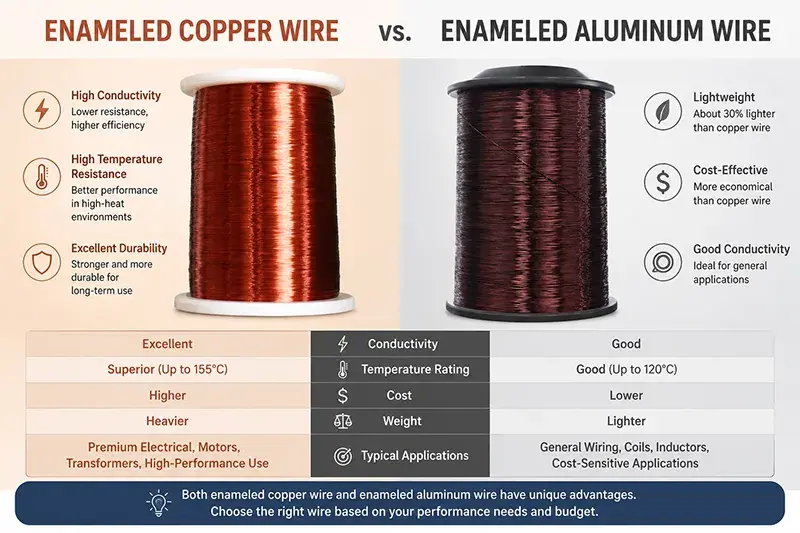
In the production of power equipment, enameled copper wire and enameled aluminum wire are the two main winding materials, both in the conductive capacity, weight cost, processing performance, heat dissipation stability on the huge differences, directly determining the product’s energy efficiency level, manufacturing costs and service life. In order to facilitate engineers to quickly compare, selection decision-making, the following multi-dimensional parameter table form, intuitively show the core differences between the two and adaptive scenarios.
| Comparison Dimension | Enameled Copper Wire | Enameled Aluminum Wire | Selection Conclusion |
| Conductivity Performance | 100% IACS conductivity, low resistivity, strong current-carrying capacity, minimal heat loss, and high energy conversion efficiency | 60% -62% IACS conductivity, resistance, heat loss is high, need to amplify the cross-sectional area of 1.6 times in order to achieve the same conductive | Effect of the pursuit of high-efficiency, low-heat, small volume of preferred copper wire. |
| Weight and Density | High density and relatively heavy, resulting in a higher overall equipment weight. | Aluminum wire has only 1/3 the density of copper wire, making it lightweight and significantly reducing the overall weight of the equipment. | Aluminum wire is the preferred choice for weight reduction needs. |
| Raw Material Costs | High copper prices lead to high raw material costs and significant procurement pressure. | Aluminum wire offers significantly lower raw material costs, with overall costs 40%-60% lower than copper wire, resulting in superior cost-effectiveness. | For extremely cost-sensitive projects, aluminum wire is the preferred choice. |
| Mechanical Processing Performance | High tensile strength, good toughness, and not easily deformed, suitable for high-speed automated winding and embedding processes, resulting in a high yield rate in mass production. | Low mechanical strength, easily deformed by tensile stress, and relatively soft material, making precision winding prone to accuracy deviations. | Copper wire is the preferred choice for automated mass production and precision machining. |
| Welding and Wiring Reliability | Excellent solderability, stable joints, not easily loosened, extremely low wiring failure rate, and simple maintenance. | However, the surface is prone to oxidation, making welding difficult and complex. Long-term high-temperature operation can lead to joint loosening and oxidation failure. | Copper wire is the essential choice for long-life, high-reliability applications. |
| Heat Dissipation and Thermal Stability | High thermal conductivity, fast heat dissipation, and low coefficient of thermal expansion make it less prone to failure and aging under long-term high-frequency, high-temperature, and heavy-load operation. | Poor heat dissipation performance, high coefficient of thermal expansion, and susceptibility to deformation due to temperature fluctuations result in poor operational stability. | Copper wire is preferred for heavy-duty, continuous-operation equipment. |
| Core Adaptive Scenarios | New energy motors, high-end transformers, precision electronics, industrial control equipment, long-life, high-efficiency energy-saving equipment | Large static transformers, HVAC equipment, low-precision high-power equipment, cost-effective products with no requirements for volume efficiency | On-demand matching, balancing performance and cost |
Overall selection of the golden principle: the pursuit of high performance, high efficiency, high stability, long service life of high-end equipment, give priority to the choice of enameled copper wire; only static energy storage, unlimited volume, cost-sensitive general-purpose large-scale equipment, you can choose the enameled aluminum wire; if you need to take into account the cost-effective performance, you can use the copper-clad aluminium (CCA) enameled wire as a compromise between the program, balancing the cost and the use of experience.
How to Choose the Right Enameled Copper Wire
Accurate selection is to ensure stable operation of equipment, reduce the failure rate, the key to controlling production costs, combined with industry standards and practical experience, summed up a set of standardised selection process, suitable for all electromagnetic winding equipment development and procurement.
The first step, clear equipment requirements. First determine the type of equipment (motor, transformer, inductor, sensor, etc.), operating voltage, rated current, operating frequency, continuous maximum temperature, ambient humidity, whether there is corrosion, vibration, impulse voltage and other special conditions, lock the core performance requirements.
The second step is to match the temperature resistance level. In accordance with the ‘reserve 20-30 ℃ temperature redundancy’ principle of selection, ordinary room temperature equipment selection of 130-155 grade, conventional industrial heavy-duty equipment selection of 180 grade, new energy, high-temperature inverter equipment selection of 200 grade and above, the extreme conditions of the selection of 220-240 grade high-end wire.
The third step, determine the wire gauge and shape. Precision small coil selection of round winding wire, ultra-fine specifications; conventional general-purpose equipment selection of standard round wire; high power, high power density, equipment miniaturisation needs, priority selection of flat wire to enhance the filling rate; special narrow space conditions selection of square enameled wire. According to the industry standard of current density 3-6A/mm², calculate the appropriate wire diameter, balance the current-carrying capacity and the number of turns.
The fourth step is to select the insulation material and film thickness. Precision electronics, need to directly weld the scene selection of PU polyurethane material; general industrial scene selection of PE, PEI material; high-temperature corrosion, heavy-duty conditions selection of PAI composite coating; extreme high-temperature special scenes selection of PI polyimide material. For regular working conditions, use 2-level medium paint film, for low-pressure precision scenes, use 1-level thin paint film, and for high-pressure impulse conditions, use 3-level thick paint film.
The fifth step is to match the special function and conductor material. For high-frequency conditions, use Litz wire, self-bonding wire for skeletonless coils, and corona-resistant wire for inverter equipment; for the pursuit of ultimate performance and long-lasting stability, choose pure copper conductor, for cost reduction and weight reduction, choose aluminium wire, and for cost-effective compromise, choose copper-clad aluminium.
Sixth step, compliance verification. Selection of wire needs to comply with IEC 60317 international standards, NEMA MW 1000 North American standards, JIS industry standards, to ensure that the equipment is compliant with mass production, export without worry.
Main Applications of Enameled Copper Wire
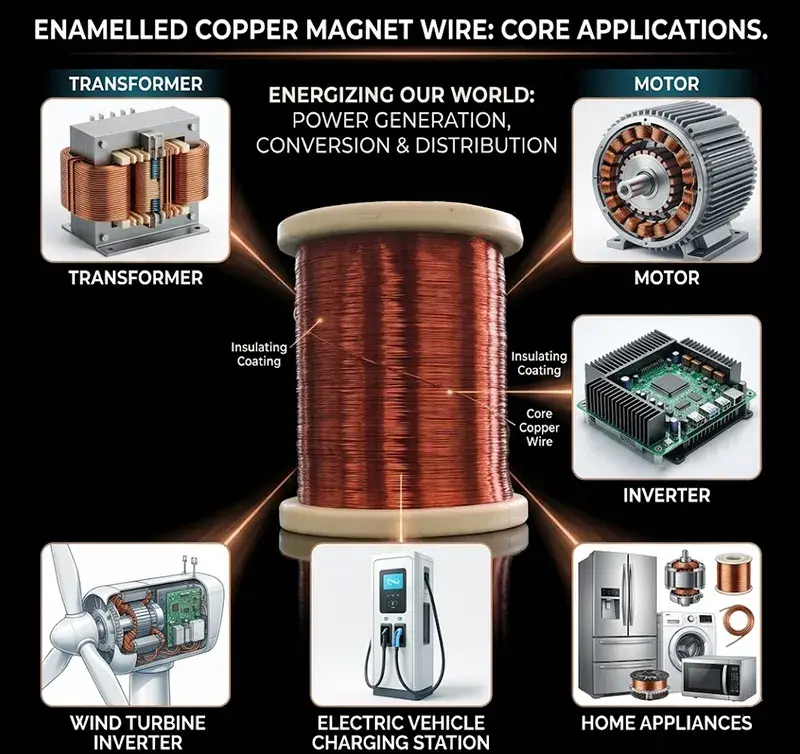
As a core material for electromagnetic energy conversion, enameled copper wire covers the whole electrical industry, from civil consumer electronics to high-end industry, new energy, aerospace, everywhere.
New Energy Field: new energy vehicle drive motors, vehicle transformers, wind power generator sets, photovoltaic inverters, energy storage reactors, relying on the advantages of high power density, high temperature resistance and low loss of flat wires, to help new energy equipment, energy efficient, small and lightweight.
Industrial Electric Field: high and low voltage power transformers, industrial heavy-duty motors, inverter motors, reactors, industrial control relays, relying on high insulation, high temperature resistance, anti-aging characteristics, suitable for industrial continuous heavy-duty operating conditions.
Consumer Electronics: headphones and speakers, miniature sensors, smart home motors, power inductors, precision coils, with ultra-fine round wires and weldable enameled wires, to meet the demand for precision and compactness, and rapid mass production.
Rail Transport and Special Equipment: high-speed rail traction motors, rail transport transformers, aerospace special coils, military electromagnetic devices, the selection of high-end enameled copper wires with ultra-high temperature resistance, radiation resistance and impact resistance to ensure the stable operation of extreme working conditions.
FAQ
Q1: What is the role of enameled copper wire?
The core function of enameled copper wire is to insulate the coil from turn-to-turn current, preventing short-circuit and leakage after winding. At the same time, it can protect the copper core from oxidation and corrosion, enhance the wear resistance and mechanical stability of the wire, so that the coil can be tightly wound at high density to maximise the power density of the equipment.
Q2: Does enameled copper wire need to be stripped of paint before soldering?
Polyurethane (PU) weldable wire does not need to be stripped of paint, 370-430 ℃ high-temperature welding can be automatically melted paint; polyester, polyimide and other common wire, must be mechanically scraped, chemical paint removal, high temperature burning and other ways to remove the paint film, in order to complete the conductive welding.
Q3: The difference between enameled copper wire and ordinary plastic insulated wire?
Enameled copper wire has extremely thin insulation layer, high fill rate, good heat dissipation, can be wound at high density, designed for electromagnetic coil energy conversion; ordinary wire has thick insulation layer, low space utilisation, only suitable for power transmission wiring, can not be used for coil winding.
Q4:How to avoid insulation failure during the use of enameled copper wire?
Core four points: matching the adequate temperature resistance level, high-pressure conditions using thick enamelled wire, processing to avoid mechanical scratching of the enamel, to prevent long-term overload and high-temperature operation, and at the same time give priority to the use of composite coatings of high-performance wires, to enhance the comprehensive protection capabilities.