
Both motor manufacturers and rewind shops have a shared challenge: Satisfy IEC 60034-30-1 IE2 efficiency levels without changing the stator slot shape. But what you use for a winding conductor is the one factor you have the most control over in that decision: The resistivity, fill factor and thermal capability of copper winding wire for IE2 rated squirrel cage induction motors puts you on target every time.
Introduction to Copper Winding Wire for IE2 Squirrel Cage Induction Motors
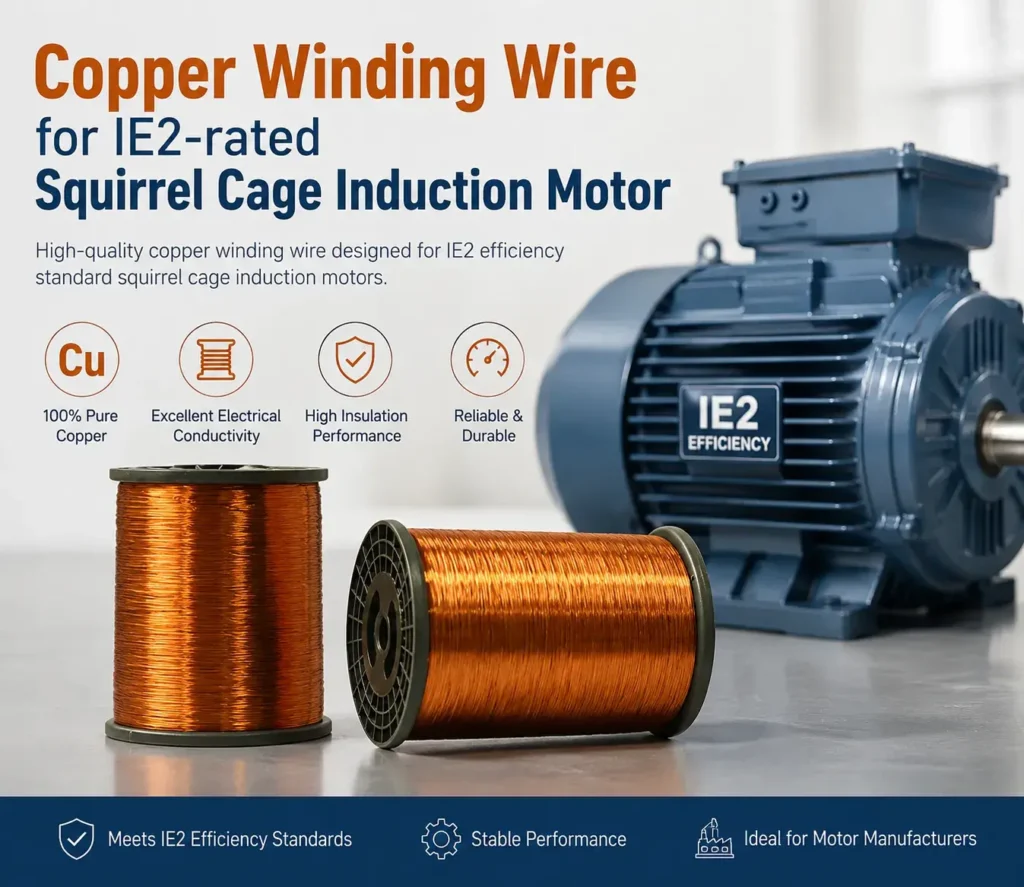
Copper winding wire for IE2 squirrel cage induction motors is enameled magnet wire with a soft-annealed electrolytic tough pitch (ETP) copper conductor and a multi-coat insulation system, is used for winding the stator of the motor.
The IE2 standard defines the minimum efficiency levels that a range of power rated motors from 0.12 k W to 1,000 k W achieve. The use of copper winding wire in the stator winding is used as part of the set minimum efficiency level. At 20 degC the electrical resistivity of copper is 1.72 x 10 m. which is 39% lower than that of aluminium. This in turn reduces the I R copper losses in the stator winding, increases the efficiency and in turn IE2 compliance.
These wires conform to IEC 60317 and are offered in Grade 1 and Grade 2 insulation constructions in a range of thermal classifications from Class F (155 degreesC) to Class H (180 degreesC). (Please confirm with us what ratings and heat ratings are available)
Key Specifications & Technical Parameters
Class 400 Copper Winding Wire of 19 SWG size specifically suitable for continuous operation in high-temperature environments (300°C to 400°C). The winding wire uses for rewinding an IE2-rated Squirrel Cage Induction Motor. Engineers design it for Canned Motor Pump in high-temperature fluid handling applications with high performance.
As Class 400 insulation is a specialized requirement
Temperature Resistance: Continuous operation in the 350°C to 400°C range
Usage: For high-temperature Canned Motor Pump (IE2 Squirrel Cage Induction Motor)
Wire Size: 19 SWG (Standard Wire Gauge)
Conductor Type: Copper
Insulation Class: Class 400 (or closest available alternative for this temperature range)
Types of Insulation
| Coating Type | Max Temp | Key Properties | Use Cases |
| Polyurethane (PU) | 130°C | Solderable without stripping | Small transformers, relays |
| Polyesterimide (PEI) | 180°C | Thermal shock resistance | Motors, industrial equipment |
| Polyamide-imide (PAI) | 240°C | Extreme heat/chemical resistance | Aerospace, EVs |
| Enamel + Fiberglass | 200°C+ | Mechanical protection | High-voltage transformers |
This is special enameled copper winding wire, LP Industry can’t produce this size wire. We just supply temperature index 155C, 180C, 200C and 220C enameled copper wire.
How Winding Wire Specification Drives IE2 Efficiency
IE2 compliance is not a motor design achievement alone. It is simply the arithmetic outcome of controlling four loss components, copper losses, iron losses, friction losses and stray losses. Copper losses are between 25% and 40% of the power losses in a standard squirrel cage motor design rated to IE2 efficiency. The winding wire specification directly influences the copper losses.
The mechanism works in four steps:
Conductor cross-section selection a larger current-carrying diameter conductor has a lower winding resistance (R ). This reduces the I2 R losses when carrying the maximum current.
Filling factor of the slot Narrower diameter tolerance and steady enamel build allow us to use most of the copper cross section in each stator slot.
Resistivity under load conditions The predictable resistivity-temperature relationship of pure ETP copper enables engineers to determine copper losses accurately at the rated thermal steady state.
Insulation build conformance Grade 2 (double-build) enamel dielectric integrity is preserved at Class F operating temperatures to oppose any inter-turn shorts that would generate further local heating and efficiency loss.
A 1% reduction in copper losses will result in an increase in full-load motor efficiency of between 0.5-1.0 percentage points for most standard IE2 frame sizes. (Value varies depending on application, check with motor design simulation data)
Core Benefits
Low electrical resistivity (<1.724×10 ) -> overhead cannot provide an IE2 efficiency advantage for either rated power output. This is due to a maximum power loss reduction of up to 39% (compared to aluminium winding wire) in the stator I2R copper losses alone.
Tight conductor diameter tolerance -> maximises stator slot fill factor, squeeze more copper cross-section into each slot, has no effect on lamination stack or design or increase frame size.
Grade 2 double-build insulation -> offers a thicker dielectric wall than Grade 1, limits the turn-to-turn fault risk during automated coil winding operations as well as the in service vibration environments.
Soft-annealed ETP copper conductor -> 25% of elongation at break, allows automated winding at the production speeds without work-hardening, cracking or breakage of the conductor.
Compliance to IEC 60317 -> streamlines CE marking; global export reduces cost & lead time of end user motor efficiency certification under IEC 60034-30-1 (no documentation required by OEM motor manufacturers).
Copper winding wire means magnet wire or enamelled wire and composes of copper conductor with a thin insulating coating. Manufacturers design it to create electromagnetic coils in electrical devices.
Why Copper?
Copper vs. Aluminium Winding Wire for IE2 Motors
| Parameter | Copper Winding Wire | Aluminium Winding Wire |
| Electrical resistivity (20°C) | 1.72 × 10⁻⁸ Ω·m | 2.82 × 10⁻⁸ Ω·m |
| Relative conductivity | 100% (baseline) | ~61% |
| Required conductor cross-section for same R | Baseline | ~64% larger cross-section |
| Stator slot fill impact | Higher fill, same slot | Requires larger slot or larger frame |
| Weight | ~3.4× heavier than Al | Lighter |
| Winding machinability | Excellent — standard tooling | Requires dedicated Al-compatible tooling |
| IE2 compliance suitability | Standard solution | Achievable, but requires frame redesign |
| Solder / connection method | Standard — soldering, crimping | Requires Al-rated terminals and connectors |
| Cost (material) | Higher per kg | Lower per kg |
| Total cost of ownership | Lower — no frame upsize needed | Higher when frame redesign is factored in |
| Property | Advantage |
| Conductivity | Best among non-precious metals (only silver is better) |
| Ductility | Min. size 0.01mm diameter) |
| tdermal Conductivity | Efficient heat dissipation from windings |
| Solderability | Bonds quickly witdout stripping insulation |
Apart from the enormous expense of re-winding an existing IE2 pump, the only available technical option is copper winding wire. Changing conductor material at re-wind alters the slot fill, resistance and thermal performance characteristics of the pump; it then has a different efficiency rating, and in some cases false safety certification it may not be worth it.
Differences in Electric Motor Winding Wire Requirements for IE2 against IE3 What are the difference?
In addition to the lower slip, IE3 Premium Efficiency motors will have an additional reduction in total losses over IE2, of 15–20% lower losses overall. For winding wire specification, this narrows the copper loss budget and sets the thresholds for three parameters.
Firstly, conductor diameter tolerance has to become tighter. IE3 Slot fill targets are much stricter leaving less room for diameter variation. Secondly, insulation build uniformity is more key as any variation in the enamel thickness of the windings through a batch would alter the effective slot fill and winding resistance. Thirdly, some IE3 designs are going from Class F (155 CDegC) to Class H (180 CDeg C) insulation at the higher operating temperatures, due to the more efficient, smaller thermal design.
Know that the IEC 60317-compliant wire a supplier provides will maintain the same dimensions over many production lots means you have never had to wonder whether different motor programmes are going to benefit from the same IE3 motor. The conductor material and enamel chemistry are unchanged just the tolerances and thermal class are more stringent.
Frequently Asked Questions
Q: how do you know that copper winding wire is actually an IE2 thermal class? (or IE3] I thought for copper it; s IE3 if I am not mistaken.
Class F (155degreesC) is the thermal class most commonly used for IE2 motor stator winding wire. It is based on the operating temperatures caused by rated copper and iron losses within IE2 frames at ambient up to 40 degreesC. For designs with poor cooling or intended for high-ambient conditions the higher temperature rated Class H (180degreesC) wire is often used. Nominate the wire thermal class you require based on the motor nameplate insulation class.
Q: Is copper winding wire used in most IE2 motor stators than aluminium?
Thus, copper was used, as it has an electrical resistivity which is 39% less than aluminium, thus giving the same conductor resistance in a considerably smaller cross-section. The greater fill factor will fit to the current stator slot geometry without need to expand the lamination stack or motor frame. For rewraising existing IE2 motors, aluminium would change the slot fill, winding resistance and efficiency rating and invalidate the motors certification, leaving only copper as a conductor.
Q: Which grade of insulation do I require for an IE2 motor to be rewound?
Grade 2 (double-build) insulation (according to IEC 60317) is suitable for IE2 motor stator rewinding in most situations, as it offers enhanced dielectric characteristics and improved coil pitting protection during coil insertion and operation compared to Grade 1. Grade 1 is only indicated where the original motor winding design explicitly states this, and where the slot shape fails to allow the slightly increased overall diameter of Grade 2 wire.
Q: I need to rewind an IE2 motor, what diameter of copper winding wire do I require?
The accurate conductor diameter is specified by OEM original motor data-is supplied either in the winding spec sheet from the motor manufacture or from the original nameplate. Repair shop with no access to OEM data will need to measure the original winding wire with a correct calibrated micrometer prior to stator stripping. Using a different diameter will change the winding resistance, the copper losses and the efficiency-which will remove the rewound motor from IE2 standard.
Q: Which IEC standard specifies copper winding wire for IE2 motors?
Enameled copper winding wire is regulated by the standard IEC 60317. Within the IEC 60317 standard, sub-parts IEC 60317-8 and IEC 60317-13 are for polyester-imide enameled wires and polyamide-imide enameled wires at class F and Class Hwinding wire respectively. IEC 60034-30-1 is the motor efficiency standard, which defines IE2 compliance. Both IEC 60317 and IEC 60034-30-1must be quoted together when winding wire is being specified for use on IE2 motor manufacture or for IE2 certified rewind.
A: Yes; it depends on the material specification of each wire. How do I identify IE2 or IE3 winding wire?
Yes, if the conductor diameter, insulation construction and thermal class are all compatible with the more restrictive IE3 design requirements. Because the IE3 motor has more restrictive (lower) total loss requirements than the IE2 motor, tighter conductor diameter tolerances are necessary; in certain cases, a change to Class H insulation may be necessary. The wire chemistry and base conductor remain unchanged. Make sure your supplier has the same dimensional consistency in its production lots when achieving the tighter IE3 slot fill tolerance before qualifying the wire for IE3 production.