
Transformer performance relies on the condition of each and every coil. This enameled wire for transformer winding defines the insulation integrity, thermal endurance and energy efficiency of the whole life of the equipment. If you design or manufacture distribution transformers, dry type transformers or high frequency power supplies, this is an established engineering & procurement choice.
What Is enameled wire for transformer winding?
Enameled winding wire for transformer winding to be used where transformer winding is Cu or Al conductor coated with a thin uniform film of thermally cured polymer insulation which forms the primary and secondary coil of the transformer. The film replaces the textile or paper wrapping ensuring that the winding measures can be such that it is possible to achieve a greater packing density and enhanced dielectric strength for a given coil cross section.
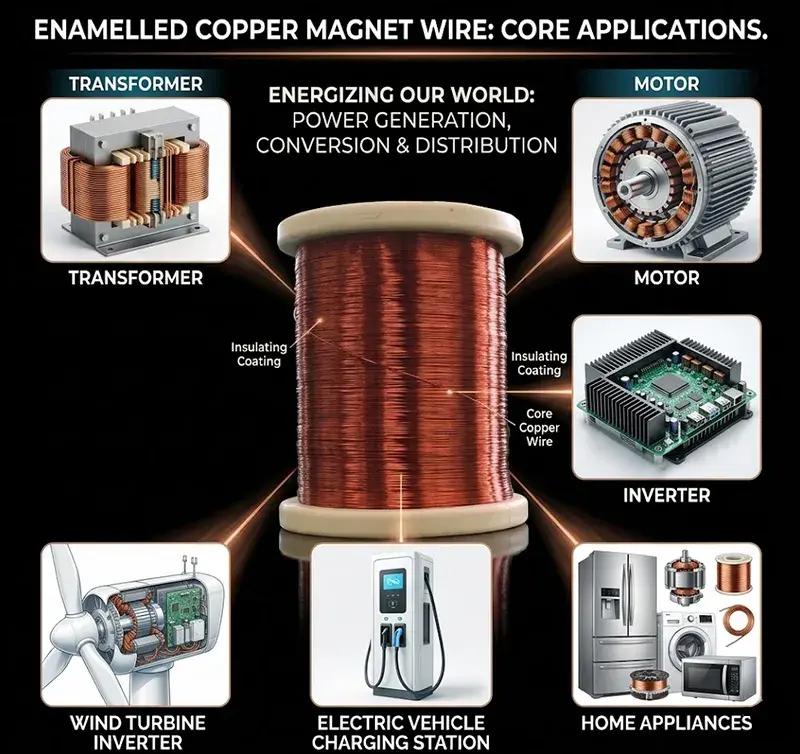
The magnetic flux that couples electrical energy from one winding to another is created by the conductors that are carrying alternating current. The enamel on winding wire insulates enameled winding wire from adjacent turns, sustains continuous mechanical and thermal stress, and prevents destructive inter-turn shorts. Well-graded enamel film in the enameled winding wire prevents transformer windings from early failure damage such as overheating, insulation breakdown, and catastrophic failure of the associated equipment.
Key Specifications & Technical Parameters of Enameled wire
| Parameter | Value |
| Conductor Material | Electrolytic tough pitch copper (ETP), aluminum alloy (verify with manufacturer) |
| Conductor Shape | Round, rectangular (flat), square |
| Conductor Diameter (round) | 0.016 mm – 9.20 mm (verify with manufacturer) |
| Insulation Type | Polyester (PEW), Polyesterimide (EIW), Polyamide-imide (AIW), Polyimide (PIW) |
| Temperature Class | 105°C (Class A), 120°C (Class E), 130°C (Class B), 155°C (Class F), 180°C (Class H), 200°C (Class C) |
| Elongation at Break | ≥ 20% (typical for copper) (verify with manufacturer) |
| Conductor Resistance | Per IEC 60317 / NEMA MW standards (verify with manufacturer) |
| Applicable Standards | IEC 60317, NEMA MW 1000, GB/T 4074, JIS C 3202 |
| Spool Weight / Format | 30 kg, 60 kg, 90 kg, PT25, PT30, PT35, PT60, PT90, PT200, PT270, custom |
| Specification of enamelled wire for transformer winding | ||||
| Products Name | Thermal Class (℃) | JIS | NEMA | IEC |
| Modified polyester Enamelled Wire | 155 | 3202-5 | MW 5-C | 60317-3 |
| Polyester-imide Enamelled Wire | 180 | 3202-8 | MW 30-C | 60317-8 |
| Modified polyester overcoat polyamide-imide Enamelled Wire | 200 | — | MW 35-C | 60317-13 |
| Polyester-imide overcoat polyamide-imide Enamelled Wire | 200 | — | MW 35-C | 60317-13 |
Enameled Wire Types: Copper vs. Aluminum Comparison
Deciding between copper or aluminum enameled winding wire is one of the most important decisions to be made during transformer coil design. Both are technically feasible; it really comes down to weight goals, price, and winding configuration.
| Property | Enameled Copper Wire | Enameled Aluminum Wire |
| Electrical Conductivity | ~58 MS/m (reference standard) | ~35 MS/m (~60% of copper) |
| Conductor Cross-Section Required | 1× (baseline) | ~1.6× for equivalent resistance |
| Weight (same resistance) | Heavier | ~50% lighter |
| Material Cost | Higher | Lower |
| Solderability | Excellent | Requires special termination |
| Winding Tension Tolerance | High | Moderate (more brittle) |
| Typical Application | High-efficiency, compact transformers | Large distribution transformers where weight and cost savings outweigh size penalty |
Selection guidance: Use copper enameled wire for high frequency, small or precision transformers where coil space is limited. Use aluminum enameled wire for large oil immersed distribution transformers where minimising conductor cost and overall weight are main design criteria.
Common transformers and the corresponding Enameled wire heat resistance grade
| Transformer type | application | Features | Heat resistance grade |
|---|---|---|---|
| power transformer | Transformation and distribution of power systems | Large capacity, high voltage level, high efficiency, stable operation | Class B or F |
| Electric locomotive transformer | Traction of electric locomotives | Small size, light weight, vibration and impact resistance | Class F or H |
| Industrial transformer | Industrial production | Various varieties, diverse structures and strong adaptability | B , Class F or Class H |
| Electronic transformer | Electronic equipment | High frequency, small size, high efficiency | Class F or H |
| Large transformer | Capacity greater than 1000kVA | High power, large volume, inconvenient to transport | Class B or F |
| medium transformer | Capacity is 100~1000kVA | Moderate capacity and wide application range | Class B or F |
| small transformer | Capacity less than 100kVA | Small size, light weight and low price | Class B |
| dry type transformer | No cooling medium is used | Safety and environmental protection, good fire protection performance, low maintenance cost | Class B or F |
| Oil-immersed transformer | Use oil as cooling medium | Good heat dissipation performance, large capacity and high efficiency | Class B or F |
How Enameled Wire Works in a Transformer?
The insulation applied to bare conductor in successive layers via a coating die and curing oven. Each pass deposits a very thin layer of polymer film. A sequence of passes will build up a film of between 10 and 100 micrometers depending on the specified insulation grade.
Inside a wound coil, each turn of conductor is separated from the next by this film. The dielectric strength of the enamel which in normal grades ranges from 3,000 to 7,000 volts stops the current jumping from turn to turn at working voltage, while the thermal class of the insulation allows for the highest possible continuous temperature the coil can operate at without being damaged. Buyers who under-specify the temperature class will have increased aging and decreased transformer life.
LP Industry production capacity for transformer winding wire
What LP industry makes transformer winding wire uses are far more, improved and perfection at allprocess from raw material production, to special packaging. An summarized versionof manufacturing strengths of them are as follows:
Advanced Manufacturing and Coating Technology
The first step in the manufacturing process is 9.5mm high quality metal wire. It is redrawn by passing through precision dies to the specified diameter. The most impressive aspect of the company‘s manufacturing machinery is the Mold Coating process, it is capable of applying three layers of electrical insulation paint film, with uniform thickness from 60 to 450 m of uniform volts and insulated properties. It is extremely heat resistant and does not crack even at 350 degreesC.
Precision Curing and Winding
For the insulation to be firm, LP Industry employs state-of-the-art infrared oven systems to individually time and control the temperature for curing the material uniformly. As regards winding procedure, a patented lubricated oil coating is adopted to lower friction so that automatic variable speed machinery may work more efficiently and efficiently. Also, micro-winding machines are incorporated for high precision winding with controllable speed, tension, and angle in free joint-carrying sizes between 5kg and 200kg.
Quality Assurance and Logistics
Whole process line of quality controls is in place. The detailed test reports on customer‘s demand, including material certificates, film thickness of paint, dielectric losses, breakdown tests, elongation and resilience data are production. The products are secured onto the custom-built wooden-reels (cylindrical or cone-shape) capable of weighing up to 200kg. The packaging materials are moisture-proof and shock-proof for transit protection.
Customization Options & Buying Guide Transformer Winding Wire
Standard round enameled wire is suitable for most transformer winding applications. Several parameters must be clearly specified before ordering.
Conductor shape: Round wire works well with most winding machines and is appropriate for use in toroids. Flat (rectangular) enameled wire is used in power or distribution transformers in the low-voltage, high-current windings, as it provides higher copper fill factors than round wire in rectangular winding windows.
Insulation build: Single-build (Grade 1) film provides the lowest insulation maximum packing density. Double-build (Grade 2) adds dielectric margin and improves mechanical abrasion resistance during the winding process. Heavy-build (Grade 3) is required for all high-voltage windings with strict inter-turn voltage stress requirements.
Finish variations: Self-bonding enamel types (solderable) can be broken in without stripping tools at tinning time. Bond-coated wire is coated with a thermoplastic outer layer which melts when heated and welds coils together. No varnish impregnation is needed in some designs.
Conductor purity: Select IEC Grade 1 electrolytic copper for lowest resistivity and best solderability. (Confirm grade of conductor purity with manufacturer.)