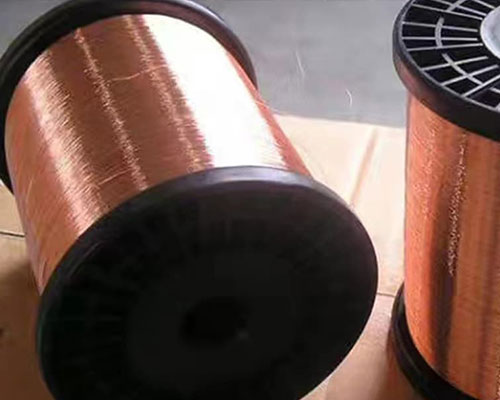
What Is Enameled Copper Winding Wire?
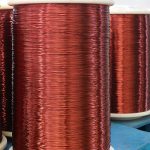
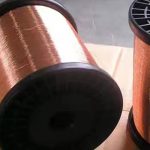
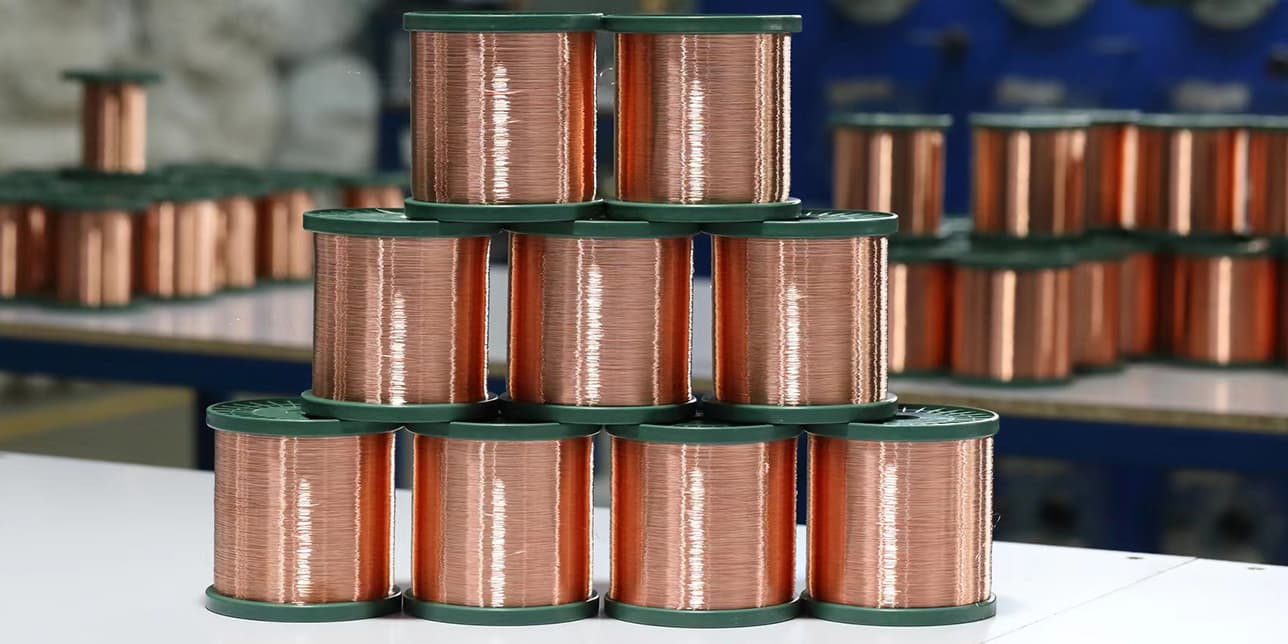
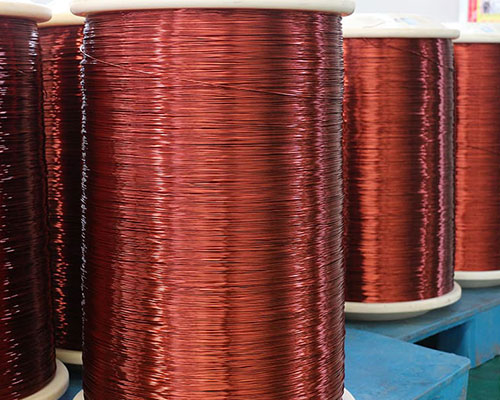
Enameled copper winding wire (also called magnet wire) is copper conductor insulated with thin layer of electrical dielectric material for winding of coils, transformers, motors and inductors.
The 0.4mm diameter indicated is that of the bare conductor prior to the coating of insulation. This is fine-wire territory so is expected to be used in winding with a high turn-count requiring minimum slot space but not wanting to affect electrical performance.
The usual coating for a magnet wire is polyurethane (PUR), polyester-imide (PEI) or polyamide-imide (PAI) and each has its own limits between thermal, flexibility and chemical properties. Each layer is very fine and built up several times of to produce a smooth, dielectric coating between turns that does not increase the conductor too much.
Enamelled round copper winding wire The international standard for enameled round copper winding wire is set out by IEC 60317 and details the tolerances, coatings and test procedures for each of the insulation classes.
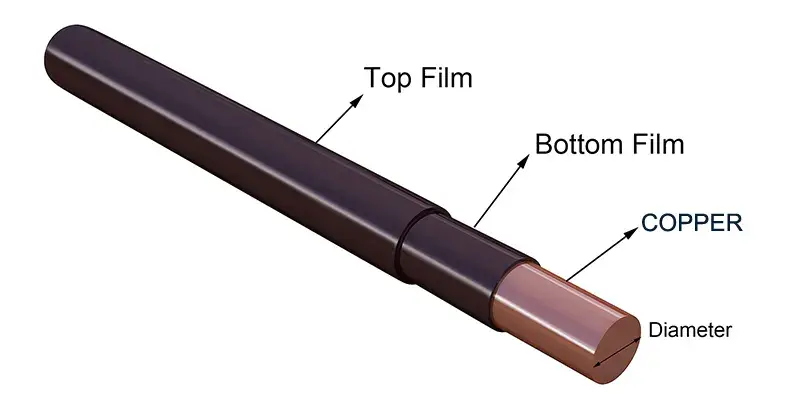
Key Specifications & Technical Parameters
Below is a detailed specification table for 0.4mm enameled copper winding wire:
| Parameter | Value / Range |
| Conductor Material | Electrolytic copper (ETP or OFC) |
| Nominal Conductor Diameter | 0.400 mm (AWG 26) |
| Conductor Diameter Tolerance | ±0.004 mm (verify with LP Industry) |
| Overall Diameter (Grade 1 / 2) | 0.426 mm / 0.440 mm (verify with LP Industry) |
| Insulation Class | B (130°C), F (155°C), H (180°C), C (200°C+) |
| Common Coating Types | PUR, PEI, tdEIC-PEI, PAI, dual-coat (PEI/PAI) |
| Dielectric Breakdown Voltage | ≥ 2,000 V (Grade 1); ≥ 3,000 V (Grade 2) (verify) |
| Elongation at Break | ≥ 15% |
| DC Resistance at 20°C | ~0.136 Ω/m (verify with LP Industry) |
| Tensile Strengtd | 190–240 N/mm² (typical for 0.4mm ETP copper) |
| Standard Spool Sizes | 26 kg – 30kg per roll |
| Applicable Standard | IEC 60317-0-1, IEC 60317-3, IEC 60317-13 |
How Enameled Winding Wire Is Made?
Manufacturing enameled winding wire involves four tightly controlled stages:
Drawing of rods. Copper rod (ETP or oxygen free (OFC)) is drawn through a series of decreasingly larger dies until the rod has a diameter of 0.4mm (+/-0.004mm).
Annealing – The wire is drawn through an annealing furnace. The ductility is restored so it can be wound and bent without cracking at tight radii.
Application of the enamel: the liquid enamel is brushed on (dipped), employing a die or felt applicator by several thin passes. Each pass deposit 5–15 m of insulation. The application thickness depends on the insulation grade required.
Curing – The coated wire passes through a curing oven at carefully controlled temperatures. This cross links the polymer forming a hard, adherent dielectric film.
This process yields wire with uniform geometry and insulation integrity right around the spool from the first meter to the last.
Insulation Class Guide
Designs of motors and transformers often include specification mistakes of the incorrect Insulation Class. Cross-refer to the chart to determine the optimum Thermal Index for the application.
| Class | Temperature Index | Typical Coating | Recommended For |
| B | 130°C | Polyurethane (PUR) | General-purpose transformers, low-heat inductors |
| F | 155°C | Polyester-imide (PEI) | HVAC motors, industrial solenoids, ballasts |
| H | 180°C | THEIC-PEI or PAI | High-efficiency motors, automotive coils, inverters |
| C | 200°C+ | Dual-coat (PEI/PAI) | Aerospace, traction drives, high-frequency converters |
Choose Class H, for application where winding is subjected to continuous temperatures exceeding 155 degrees C (C), or where the winding is to be designed to operate under cyclic thermal loading, with hot-spot temperatures constantly surpassing the Class F limit.
Where high solderability is preferred – for example, bobbin coil or PCB transformers – Class B poly wire can be soldered at the tip without stripping the insulation if the tip temperature is above 380 degrees C.
Core Benefits of 0.4mm Enameled Copper Wire
High conductivity copper conductor-> resistivity of about 0.0171 mm2/m at 20 degreesC, less winding resistance, and I2R losses than copper- Aluminum conductors.
Precision diameter tolerance (+/-0.004mm)-> uniform wire lay throughout the winding, predictable slot fill ratios and standardized inductance across production runs.
Thin dielectric build -> maximizes copper fill in a given winding window by packing more turns into each slot without increasing the core geometry.
Multi-class insulation options->one conductor size available in Class B to Class C ratings will enable the same winding tools to be used to produce parts designed for various thermal enviroments.
Flexible enamel compositions-> PUR coating for direct solder connections; PAI dual-coat for refrigerant and transformer oil immersion applications.
IEC 60317 conformance-> independently validated dielectric strength, elongation and thermal shock performance, providing qualification risk reduction for regulated end products.
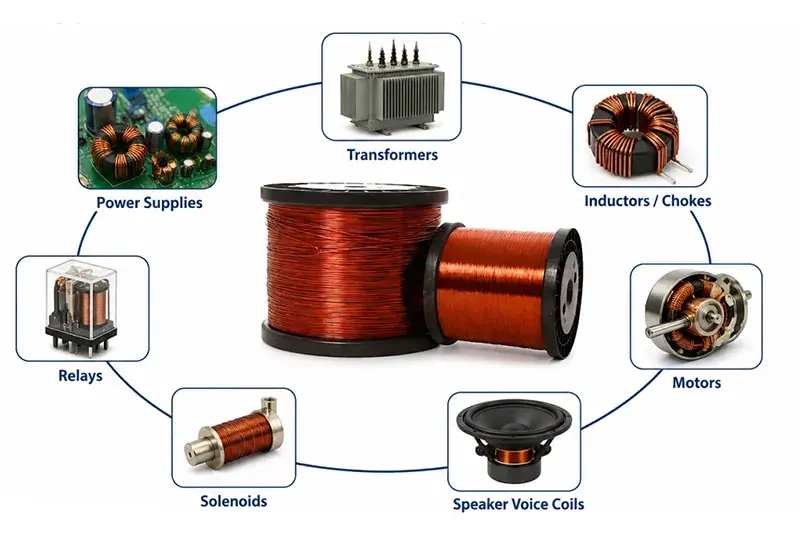
Applications & Use Cases
Enameled copper winding wire 0.4mm is ideal for any situation where a high winding turn count is desired, but otherwise a small size package is needed. The size is close to a manageable tolerances: thin enough for tight coil geometries, but still thick enough to be wound on an automated machine without snapping ten times a minute
Typical applications include:
Electric motors of fractional horse power – ceiling fans, power tools, appliance motors, BLDC drives
Power transformers and switching mode power supplies (SMPS) primary and secondary windings in a high frequency ferrite core.
Inductors and chokes. usual-mode filters, energy-storing inductors in DC-DC converters;
Magnetic solenoids-actuators and electromagnetic relays-coils of high ampere-turns within relatively small axial length.
Automotive sensors and actuators ABS coils, throttle position sensors, fuel injector solenoids
Medical device transducers/probes where compact geometry and dimensional consistency are key
Additional areas of specialisation: Custom coil winding bobbin, toroidal and air-core inductors for RF and audio use
Buying Guide: Selecting the Right 0.4mm Winding Wire
There are many various factors involved, which will conclude on which type of 0.4mm enameled copper wire to be used for this device.
Step 1 – Verify the insulation class. Determine the maximum continuous operating temperature at the hottest spot of your winding. Allow 10 – 15 C safety margin, select the next higher class.
Step 2 – Choose coating. Use polyurethane (Class B/F) if the wire needs to be jacketed and soldered directly on installation, or choose polyester-imide or dual coating (PAI) if the winding is to be subjected to varnish impregnation, coolant dipping, or refrigerants.
Step 3 – Select insulation class: For Class 1, select the thinnest possible construction and highest possible slot fill. For Class 2, select the highest dielectric strength possible for high-voltage windings. If winding operation exceeds 500 VAC, enter at least Grade 2.
Step 4 – Spool format. Automated winding machine commonly traverse winder spools 27kg or 30kg, hand or protype winding, 0.5kg spools may be used. Check all measurements are suitable for your winding machine‘s creel.
Step 5 – Test for batch to batch consistency. In the case of production windings, require CoC documentation and spooil-by-spooil diameter test reports to check for inter spool consistency.
Enameled Copper Wire vs. Alternatives
| Wire Type | Conductivity | Weight | Cost | Solderability | Best For |
| Enameled copper Wire(0.4mm) | High (100% IACS) | Standard | Medium | Yes (PUR grade) | Most motor, transformer, coil applications |
| Enameled aluminum Wire | Moderate (61% IACS) | ~30% lighter | Lower | No (requires crimping) | Weight-sensitive applications where conductivity can be traded |
| Bare copper wire | High | Standard | Similar | Excellent | Connections, bus bars; not suitable for multi-turn windings |
| Served/textile-wrapped wire | High | Heavier | Higher | No | Specialty audio, high-flexibility applications |
| Litz wire (stranded, enameled) | High | Heavier | Much higher | Limited | High-frequency (>50 kHz) where skin effect losses dominate |
Another very significant conductor is 0.4mm enameled copper wire which is often the right choice for the overwhelming majority of motor, transformer, and inductor applications under 50kHz. Only where mass reduction is an end in itself and the winding termination allows crimped joints should enameled aluminum even be considered.
Frequently Asked Questions
Q: What is the difference between Grade 1 and Grade 2 insulation for 0.4mm enameled copper wire?
Grade 1 has a somewhat thinner enamel build, so has a somewhat smaller diameter and higher copper fill factor. Grade 2 (a heavier build) can provide a higher dielectric strength, typically 3,000 V and above. Grade 2 is a more appropriate specification for windings operating above 500 VAC or where surge voltages are higher. Both grades are IEC 60317 compliant.
Q: Is it possible to tin 0.4mm vanE ttencopper wire without stripping?
Yes, if the wire is detailed with a PUR coating. PUR enamel will self strip in a solder bath providing temperatures rise above 380 degreesC, therefore no wire stripping (chemical or abrasive) is required prior to solder termination. PEI and PAI coatings will not self strip.
Q: what is the AWG of 0.4mm enameled copper wire?
A: 0.4mm bare conductor diameter converts to about 26 AWG (Awg actual conversion is 26.35 Awg). For practical purposes, this scale is very close to the standard wire gauge (26AWG) with a diameter of 0.405mm. In all practical winding designs these two needles are interchangeable. Check the mechanical and electrical requirements are within your design constrain in the relevant gauge system.
Q: What temperature class should I specify for a motor operating at 130°C?
A: Specify Class F (155 degreesC temp index) at least. Class B (130 degreesC) is not good enough since the intended temp index shall be greater than the maximum hotspot temperature by 20-25 degreesC to have enough insulation life under continuous operation. If there will be thermal cycling or high ambient temperature, choose Class H (180 degreesC).
Q: What is the minimum order quality for 0.4mm enameled copper winding wire?
Our Minimum order quantities is about 500kg per size. Check with supplier for confirmation of availability and MOQ for your specification.
Q: Is enameled copper winding wire compatible with varnish impregnation processes?
Yes. Enameled copper wire is suitable for all standard varnish impregnation (trickle, dip-and-bake, vacuum pressure impregnation). Polyester-imide and dual-coat PAI/PEI enamels are resistant to solvent based and epoxy varnish systems. Check chemical compatibility between your proposed (specific) enamel formulation and varnish system with your wire supplier prior to production qualification.
Please contact our team for custom specifications, volume pricing and lead time confirmation. We all respond within 24 hours.