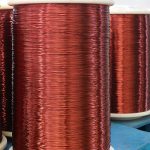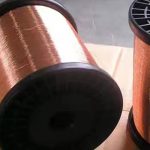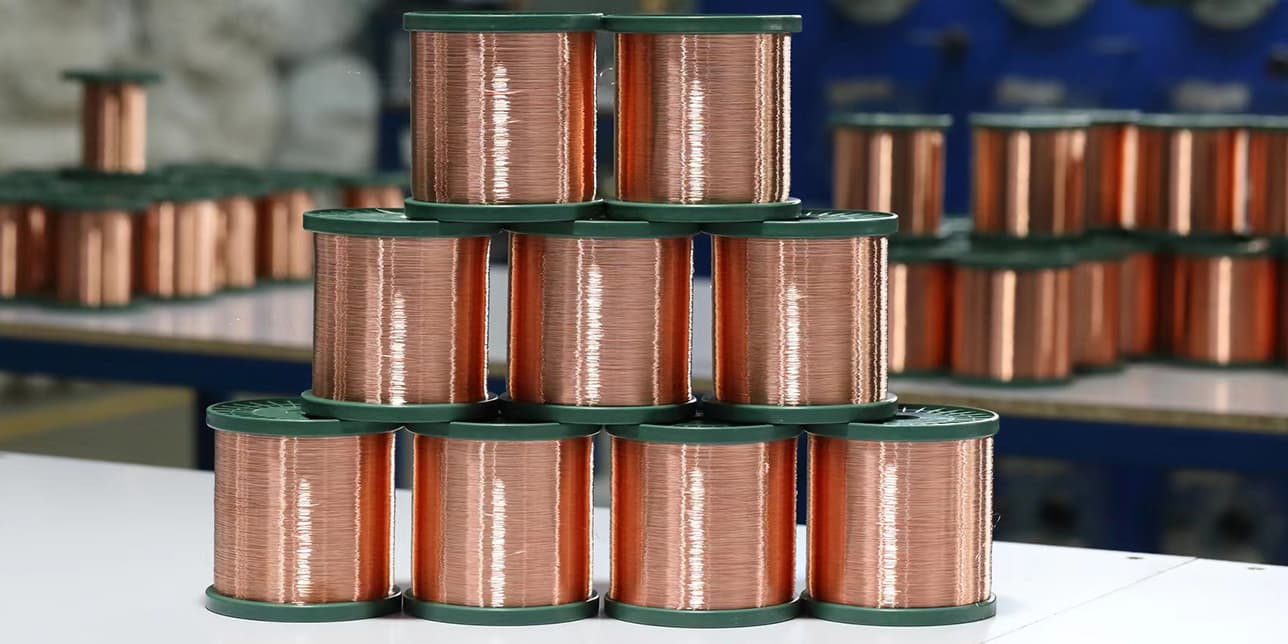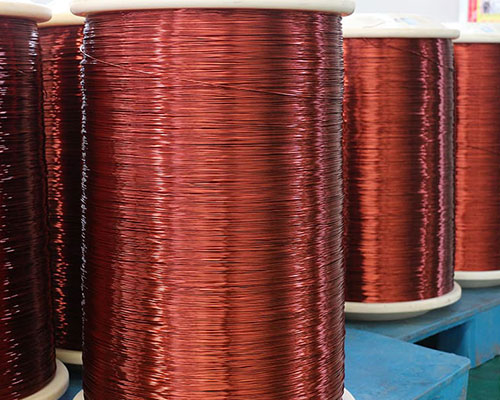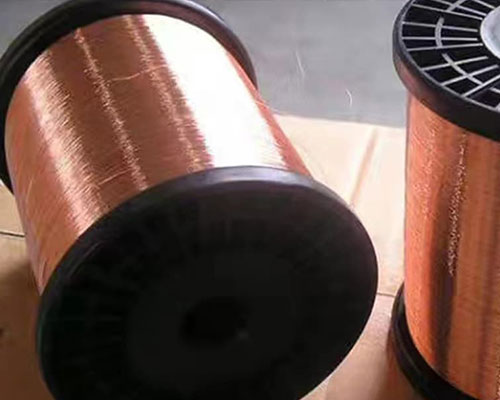
Motor windings, compressor coils and high temperature transformers require long-term insulation performance that withstands elevated operating temperatures as opposed to short duration transients. 200 °C Polyesterimide Enameled Round Copper Wire, Grade 2, AWG16 to AWG23 provides 8 heavy-gauge sizes of Class 200 continuous insulation, ensuring long term coil assembly performance where lesser grades would otherwise prematurely deteriorate.
What is 200 ℃ Polyesterimide Enameled Round Copper Wire?
200 ℃ Polyesterimide Enamelled Round Copper Wire is a magnet wire with 99.985% pure copper conductor covered with PEI (Polyesterimide) insulating coating. This is Class 200 in line with worldwide thermal endurance tests.
The polyesterimide resin is applied in several very thin coats and oven cured to form a continuous pinhole free film. Insulation has a minimum temperature index of 200, a heat shock withstand temperature of at least 220 ℃ and higher mechanical and chemical resistance than the standard polyester grade.
Grade 2 enamel is of a thicker build than grade 1. It offers increased dielectric strength, increased conductor-to-conductor abrasion resistance and increased robustness during high density coil winding.
AWG16 to AWG23: this description encompasses conductors with diameters from approximately 0.511 mm (AWG23) down to 1.291 mm (AWG16). This is the heavy-gauge section, recommended for high-current capability with constant high-temperature performance.
International standard IEC 60317-84 regulates the conditions of use of the polyesterimide enamelled round copper winding wire, class 200.
How the Polyesterimide Insulation System Works
Polyesterimide resin is prepared by condensation of polyester with the imide-ring-forming ingredients. It is the imide ring structure that confers the essential heat stability characteristic to this chemistry, over and above the raw polyester coatings.
The wire (conductor) is drawn to the specified AWG diameter and then drawn through an oven with a vertical or horizontal path where they spray the enamel coating on in several fine layers which are heat cured to predetermined conditions. Each time the wire passes through the oven cabinet it increases in film thickness until the Grade 2 limits are attained.
The film after cure adheres strongly to copper. The imide rings in the polymer backbone are resistant to termination and chain scission at high temperature, therefore dielectric and mechanical properties are preserved after burial for thousands of hours at 200 °C.
What we end up with is a winding wire that resists softening on thermal heating, systems film adhesion while forming the coil and survives the voltage stress throughout the life of the rated usage.
Key Specifications & Technical Parameters
| Parameter | Value / Range |
| Thermal Class | 200 (Class C per IEC/NEMA) |
| Temperature Index | ≥200 (per IEC 60172, 5,000 h test) |
| Heat Shock Temperature | ≥220°C (verify with manufacturer) |
| Conductor Gauge Range | AWG16 to AWG23 |
| Conductor Diameter Range | ~0.511 mm (AWG23) to ~1.291 mm (AWG16) (verify per IEC 60317-0-1 table) |
| Film Build | Grade 2 (thicker enamel; refer to IEC 60317-84 film thickness tables) |
| Dielectric Breakdown Voltage | ≥5 kV (Grade 2, heavier gauges) (verify per gauge with manufacturer) |
| Elongation at Break | ≥15% (verify per IEC 60317-84 Table 4) |
| Conductor Purity | ≥99.9% electrolytic-grade copper |
| Governing Standard | IEC 60317-84; IEC 60317-0-1 |
| Equivalent Standards | NEMA MW 35-A; GB/T 6109 |
AWG16–AWG23 Conductor Dimensions Reference
| AWG Gauge | Nominal Conductor Ø (mm) | Typical Grade 2 Overall Ø (mm) | DC Resistance at 20°C (Ω/km, approx.) |
| AWG16 | 1.291 | ~1.360 | ~13.2 |
| AWG17 | 1.150 | ~1.218 | ~16.6 |
| AWG18 | 1.024 | ~1.090 | ~21.0 |
| AWG19 | 0.912 | ~0.976 | ~26.5 |
| AWG20 | 0.812 | ~0.874 | ~33.4 |
| AWG21 | 0.723 | ~0.783 | ~42.1 |
| AWG22 | 0.644 | ~0.702 | ~53.1 |
| AWG23 | 0.573 | ~0.630 | ~66.8 |
(All dimensions and resistance values are indicative. Verify against the manufacturer’s published dimensional tables and IEC 60317-0-1 for tolerance ranges.)
Core Advantages of 200 ℃ Polyesterimide Enameled Round Copper Wire
High Thermal Resistance and Endurance
Resistant to 200 °C for continual use and able to withstand continuous exposure for long durations at high temperature without loss of insulating performance, dielectric properties or mechanical properties. Therefore shortor long-term exposure at high temperature will not cause breakdown, thermal shock or softening. Suitable for more arduous applications such as electric motors, transformers, refrigeration units.
Excellent Electrical Insulation and Dielectric Strength
They have a good electrical insulating paint on them, so the only electrical time would be a short circuit, as it would allow very tight, really compact windings. As Grade 2 has a thicker Insulating than Grade 1, it has a higher breakdown voltage, and protection against voltage spikes.
Good Mechanical Properties and Windability
Flexible, abrasion resistant and adhesive, this product maintains high speed winding, drawing and coil forming with fewer breaks. Resistant to the mechanical stresses of manufacturing and operation.
Chemical and Solvent Resistance
Insensitive to impregnating agents, resins, refrigerants, oils, Freons, and many other chemicals! This guarantees reliable performance over time, even under the extreme or severe industrial and automotive conditions.
High Space Factor and Efficiency
The insulation also enables dense packing of the windings without degrading performance thereby enhancing device efficiency, heat sinking and power density.
Durability and Long Service Life
Prevents the copper conductor from oxidising and corroding. Coupled with the high conductivity of the copper it provides the optimal balance for low energy losses and high reliability performance in demanding applications.
Applications & Use Cases
AWG16–AWG23 represents the medium-to-heavy gauge band most commonly specified for power handling coils. Class 200 rating, it is the default choice for ambient conditions above the Class H (180 °C) limit or where thermal safety margins are necessary.
Specific applications include:
Refrigeration and air-conditioning compressor motor winding that hermetic compressor operating on R22, R410A or R134a refrigerants need to be thermal and chemical resistance
Industrial motor rewinds and OEM motor manufacturing H-Class and C–Class Frame motors under continuous or overload duty cycles
Dry-Type distribution and power transformers- Class 200- rated winding wire..eration are all that is needed to prevent costly additional thermal barriers when used in high- ambient-temperature locations
Inverter-fed (PWM) Traction & Servo Motors: The PEI film withstands the partial discharges from fast voltage steps caused by switching IGBTs
For example, the heat energy accumulated in isocontour of a typical industrial solenoid or electromagnet, high duty-cycle coils which will have very large total joule heating during their life-time
Automotive and Electric Vehicle auxiliary motor windings compact winding geometry with thermal headroom required
Welding equipment transformers–intermittent high current duty create localized hot spots where Class 200 insulation provides margin
Grade 1 vs. Grade 2 Film Build
Grade refers to enamel film thickness, not insulation material. Both grades use the same polyesterimide chemistry and carry the same Class 200 thermal rating. The difference is in the insulation build applied to the conductor.
| Parameter | Grade 1 | Grade 2 |
| Film thickness | Thinner (minimum per IEC table) | Thicker (approx. 1.5–2× Grade 1) |
| Dielectric breakdown voltage | Lower (per gauge) | Higher (per gauge) |
| Overall wire diameter | Smaller | Larger |
| Slot fill ratio | Higher (more conductor per slot) | Lower (thicker insulation reduces fill) |
| Abrasion resistance | Standard | Enhanced |
| Typical specification | Space-constrained coils, fine-gauge windings | High-voltage coils, heavy-gauge power windings |
Choose Grade 2 when the design voltage is elevated, when conductor-to-conductor abrasion is a concern during high-speed winding, or when the coil requires maximum dielectric protection. For AWG16–AWG23 power applications, Grade 2 is the more common specification.
200°C (Class 200) vs. 180°C (Class H)
Both Class 200 and Class H (180°C) polyesterimide wires are specified for demanding thermal environments. The choice depends on continuous operating temperature, thermal safety margin requirements, and applicable equipment standards.
| Parameter | Class H — 180°C | Class 200 |
| Temperature index | ≥180 | ≥200 |
| Heat shock temperature | ≥200°C | ≥220°C |
| Governing standard (sole PEI coat) | IEC 60317-8 | IEC 60317-84 |
| Typical applications | Standard H-class motors, dry transformers | C-class motors, compressors, inverter drives, high-ambient industrial equipment |
| Cost premium | Reference | Moderate premium (verify with manufacturer) |
Class 200 should be specified if: design operating temperature approaches or exceeds 180°C, a Class C insulation is mandated by equipment standard, greater chemical resistance is needed due to refrigerant contact or a long service life in the presence of thermal cycling is an important reliability driver.
Class H is still a cheap solution for applications that find the 180 °C upper ceiling acceptable.
Compliance & Standards
Our products comply with international standards such as IEC 60317-13, NEMA MW 30-C, and GB/T 6109.13. Customizations for insulation thickness, color, or packaging are available upon request.
Frequently Asked Questions
Q: Is a 200° C polyesterimide wire hermetically sealed for the windings of a compressor motor?
Yes, the polyesterimide insulation has a high thermo endurance and is compatible with most typical refrigerants such as R22, R410A, R134a and R600a. Confirm this with the manufacturer‘s chemical resistance datasheet and check before final specification of the design.
Q: What IEC specification is this product according to?
The basic standard for Polyesterimide Enamelled round copper winding wire, Class 200, single coated, is IEC 60317-84. The IEC standard IEC 60317-0-1 covers overall dimensions of conductor and general requirements. The equivalent North American standard is NEMA MW 35-A.
Q: Is this wire suitable for inverter fed (PWM) motor drives?
Inverter rated applications for many inverter fed motor application, Polyesterimide enameled wire, Type 2 film build, will offer a very good partial discharge resistance to the fast switching IGBT voltage pulses when the thicker film is used. In inverter duty applications that have high d V/dt, the partial discharge inception voltages (PDIV) data should be checked with the manufacturer and whether corona resistant grades are needed should be investigated.
Q: What is the conductor diameter range(from AWG16 to AWG23)in mm?
AWG23 has a nominal conductor diameter of around 0.573 mm and AWG16 around 1.291 mm. The overall diameter (conductor and Grade 2 enamel) is more significant; see the dimensions table here and check against the published manufacturers datasheet and IEC 60317-0-1 for specific tolerances for each gauge.
Why Choose Us?
As a trusted enameled wire manufacturer, we offer:
- ✔️ Fast delivery and global shipping
- ✔️ Competitive factory-direct pricing
- ✔️ Customization for special applications
- ✔️ Strict quality control and certifications
Request a Quote or Sample Today
Looking to source high-quality Polyesterimide enameled wire AWG16–AWG23? Contact us now for technical datasheets, samples, or bulk pricing.