
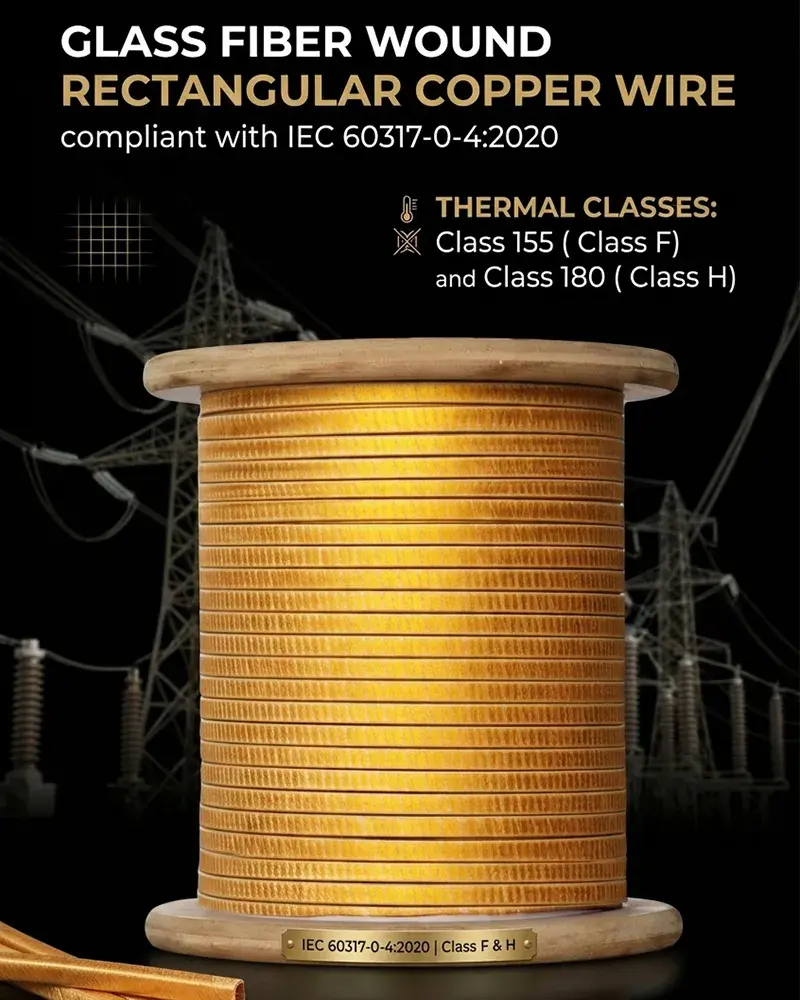
According to the IEC 60317-0-4:2020, it includes the requirements for making and performance of glass-fiber-wound, resin- or varnish-impregnated, bare, or enameled rectangular copper conductors, which are used for a wide range of electrical equipment including transformers, electric motors, reactors.
IEC 60317-0-4:2020 Overview
IEC 60317-0-4:2020, ‘Specification for electrical characteristics Part 0-4: General Electrical characteristics’ 4 lays out the general specifications for enameled or bare rectangular copper wire with a glassfiber-wound resin or varnish impregnated, bare or enameled. The specifications in this area include; dimensions, tolerances, general mechanical, electrical and thermal properties.
Key Specifications
Thermal Properties
Thermal Class: the standard notes that there are a variety of thermal classes for which the wire can be classed, according to the highest continuous operating temperature the wire can withstand. For example, Class 155 ( Class F) and Class 180 ( Class H) imply that the wire can operate at 155 degrees and 180 degrees respectively. This is an important factor when choosing the appropriate wire for use in higher temperature environments.
Thermal durability: The wire can be subjected to elevated temperatures over prolonged periods of time to test its thermal durability. For example, Class 155 wire should pass after 20,000 hours of continuous exposure to 155 degrees C without any notable deterioration.
Electrical properties A property of great importance in Biological applications is conductivity. Conductivity is defined by an electrical current flowing due to a potential difference across the substance or medium. To control this effect the electric field strength can be modified. This technique is often used on semiconductor wafers.
Dielectric strength: indicated the capacity of the wire insulation to resist electrical stress (Voltage application across the wire insulation). Usually more than 4000 V/mm is needed, which is ensured by high dielectric strength, in order to ensure safety.
Insulation resistance: The insulation resistance should be as high as possible to avoid any leakage currents which can cause short circuits. The standards set an insulation resistance limit depending on the cross-sectional area and length of the wire.
Mechanical Properties
Tensile strength; The wire should be tensile enough to sustain the forces during manufacture , installation and operation. For rectangular copper wire a utility tensile strength for the wire would possibly be in the order of 200 N/mm 2..
Elongation: performance in terms of elongation is important as well as strength. The wire must not break when stretched, which given a minimum elongation of 15% is not likely to do so. This is an important factor as it affects the ease with which the wires can be handled and installed.
Adhesion and flexibility: The insulation needs to stick well to the copper wire and be flexible enough not to break when twisted and wound up, this is to ensure the wire stays in perfect condition during installation.
Dimensions and Tolerances
Rectangular Cross-Section Sizes: Standards allow narrow tolerances on wire width and thickness. For instance, a width of 4.00 + or – 0.05 mm may be specified along with a thickness of 2.00 + or – 0.03 mm. It is important that wire is measured accurately so that it is suitable for use with other components in electrical systems.
Conductor edge radius: When the wires are rectangular they should be rounded as the edges should not damage the insulation. For example might have an edge radius of 0.20mm so that the wire does not have any sharp edges.
Surface Quality and Coating
Surface smoothness: The wire surface has to be smooth and free from defects that can induce performance loss in the insulation, such scratches. The smooth surface will help winding and lamination of electrical components.
Coating: The coating on an enameled wire should be smooth and free from pinholes. The insulating properties of the coating appear to depend on both the coating thickness and the adhesion to the copper wire.
Data Presentation
1.Thermal durability test
| Temperature | 150°C |
| Test duration | 20,000 hours |
| Insulation breakdown | No significant degradation after the test duration. |
2.Dielectric strength test
| Number of samples | 10 samples |
| Applied voltage | 5000 V |
| Number of breakdowns | 0, showing excellent dielectric strength. |
3.Tensile strength and elongation tests
| Tensile Strength | 220 N/mm² |
| Elongation | 32% |
| Number of Test Samples | 50 |
| Qualified Rate | 100% |
Impact on Manufacturers
Compliance with the IEC 60317-0-4:2020 is important for manufacturers to make sure that the product would meet the safety and performance requirement of wire.Being capable to meet the IEC 60317-0-4:2020 standard implies an achievement of strict regulation of production process and quality control in order to make sure that the wire would ensure the relevant performance requirement. IEC 60317-0-4:2020 is specific to manufacturers:
Reliability of product: Costram cores relax stringent thermal, electrical and mechanical requirements, helps ensure the winding wire reliability for customers in various applications.
Enhancemarketcompetitiveness: Meeting IEC 60317-0-4:2020 international standards makes products even more market-competitiveness.
Increase international visibility: When products meet international standards, it is easier to attract global attentions and keeps the leading position.
IEC 60317-0-4:2020 specifies wiring specifications for the manufacture of bare or enameled rectangular copper winding wire that is glass fiber wrapped and resin or varnish impregnated. These specifications are an integral part of ensuring that the winding wire complies with all relevant safety and performance specifications for use in various electrical applications. By complying with the IEC 60317-0-4:2020 specifications manufacturers are assured of being able to produce reliable, durable and high quality winding wire that adheres to standards of safety and performance on a global scale. It is through understanding and complying with the IEC 60317-0-4:2020 specifications that a manufacturer can be assured of producing the best quality magnet wire.