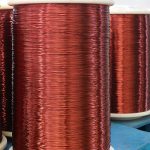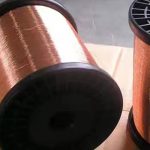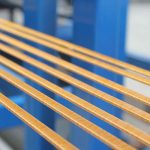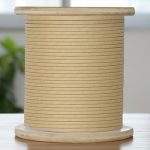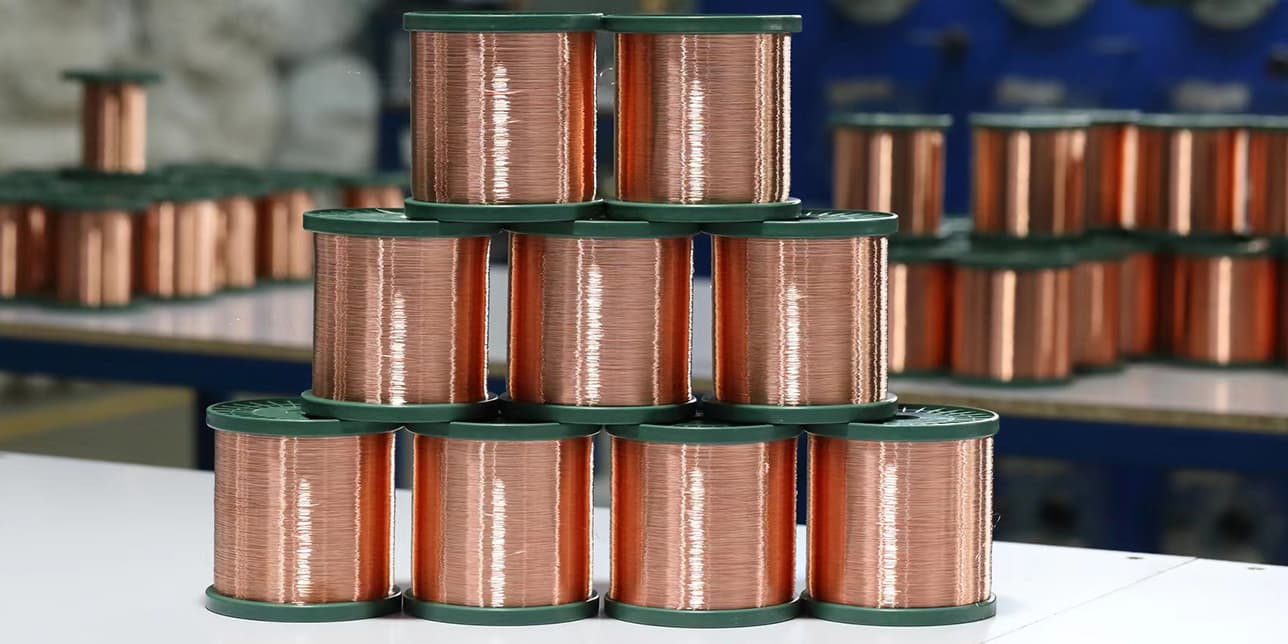
Copper wire is required for high thermal loads application. It must withstand high temperatures without insulation failure. This 3mm x 0.12mm flat copper wire with the Class G lamination has a 180degreeC continuous operating temperature, tight dimensional tolerances and high density coil winding capabilities, for use in transformer, motor and inductor applications where no thermal failure is acceptable.
What is Flat Copper Wire?
Flat copper wire is electrical wire made from copper which is flat. It is useful in various electrical fields including engineering, telecommunications, and coil making. The flat square cross section allows the surface area to be greater than round wire, aiding heat dissipation or electrical conduction.
What is 3mm x 0.12mm Flat Copper Wire with Class G Lamination?
3mm x 0.12mm flat copper wire, with a Class G lamination, is a rectangular-section electrical conductor made from high purity copper enclosed by a Class G rated insulation system, suitable for continuous operation at 180 °C. The conductor has a cross-section of 3.00mm width by 0.12mm thick and is utilized in a flat form for the purpose of layer winding and coil slot packing.
Class G lamination lamination system on top of the bare copper that gives thermal endurance, dielectric protection and mechanical durability in tight winding geometries.
Flat wire is employed in manufacturing power transformers, ultra-efficient electric motors, choke coils, toroidal inductors anywhere that a small, high-temperature winding is desired. The broad shape enables a closer packing of the turns than can be achieved with round wire of the same cross-section area, thus resulting in a smaller overall coil size, as well as a lower D. C. resistance.
How Flat Copper Wire with Class G Insulation Works?
Wire has two “active” layers: the lamination insulation and the copper conductor.
The conductor drawn to exceptionally close rectangular tolerancesfrom ETP, or oxygen free copper at a conductivity of 99.9% IACS, is: 3.00mm x 0.12mm. The purpose of which is so that a minimum resistance per unit length.
A Class G lamination is also laid on the conductor as a high temperature resistant insulating. Typical lamination systems are polyimide film, glass-fibre-reinforced resin tape or composite laminates acceding the 180 degrees C thermal endurance index used by IEC 60085 Class G classification.
The flatwire winding occurs in well defined layers into the coil former or slot in which it sits. Every turn is electrically separated by the lamination. This results in a compact, dimensionally stable winding with an easily predictable resistance and low AC losses and thermal characteristics which remains constant over the specified temperature range.
Key Specifications & Technical Parameters
| Parameter | Value / Range |
| Conductor Width | 3.00 mm |
| Conductor Thickness | 0.12 mm |
| Conductor Material | Electrolytic Tough Pitch (ETP) Copper or Oxygen-Free Copper |
| Conductivity | ≥99.5% IACS |
| Insulation Class | Class G / F — 180°C continuous operating temperature (IEC 60085) |
| Insulation System | Polyimide film / Glass-fibre resin lamination |
| Dielectric Voltage Withstand | ≥500 V AC |
| DC Resistance at 20°C | ~481 Ω/km |
| Temperature Index | 180°C (per IEC 60085) |
| Available Form | Spool / coil, customed |
| Compliance | RoHS, REACH |
Key Benefits of Flat Copper Wire 3mm x 0.12mm
Rectangular cross section geometry→ increases coil slot fill factor by 20% – 40% compared to equivalent round wire. This decreases the volume of the coil and consequently its weight in the available winding window.
Class G 180 °C insulation rating → prolongs coil life when used with high temperature application due to less insulation deterioration and early winding failures.
High purity copper conductor (99.9% IACS) → minimises DC resistance and resistive losses, leading to a more efficient coil and less heat generated under load.
Tight dimensional tolerances→ guarantees tight control of the spacing between successive windings, giving uniform inductance and reproducible electrical characteristics from batch to batch.
Laminated insulation construction→less prone to mechanical damage to insulation during winding because of better abrasion resistance than enamel only coating at sharp outside edge of coil former.
Fits automated winding machines → flat wire feeds accurately through precision winding machines with little twist, then helps produce high volumes of coils with low scrap rates.
Slot Fill Factor: Why Flat Wire Outperforms Round Wire
Slot fill factor: in a motor or transformer winding window, the ratio of the cross-sectional area of the conductor to the extent of the slot area (fill factor). A high fill factor will yield a greater proportion of copper in the given space. This will lower the winding‘s DC resistance and improve thermal transfer between the winding and the core.
Round wire leaves interstitial air pockets between conductors that cannot be avoided using standard winding techniques. Flat wire avoids most of these pockets by stacking the conductors in a series of evenly spaced rectangular layers.
| Parameter | Flat Copper Wire (3mm × 0.12mm) | Round Copper Wire (equivalent cross-section) |
| Theoretical maximum slot fill | Up to 78% | Up to 60–65% |
| Layer stacking | Ordered, gap-free | Hexagonal packing with gaps |
| DC resistance for given window area | Lower | Higher |
| Winding height for given turns | Shorter | Taller |
| Thermal conduction through winding | Improved (solid contact) | Reduced (air gaps) |
| Coil mass for given inductance | Lighter | Heavier |
In certain coil configurations where there is limited room for winding for example in thin profiles of a transformer, a narrow motor stator flat wire offers a performance benefit that cannot be achieved with round wire.
Class G Insulation Explained: Temperature Rating and Thermal Endurance
G is a class G insulation, a category of electrical insulating material according to the IEC 60085. A Class G insulation system has a temperature index of 180 °C which means it is designed for continuous operation at 180 °C without exceeding its rated thermal endurance life.
IEC 60085 classifies the insulation through temperature index classes. The most important classes for coil manufacture are:
| Insulation Class | Temperature Index | Typical Application |
| Class F | 155°C | Standard industrial motors and transformers |
| Class H | 180°C | High-temperature motors, traction equipment |
| Class G | 180°C | High-temperature coil windings, specialty transformers |
| Class N | 200°C | High-performance industrial drives |
| Class R | 220°C | Extreme-temperature applications |
Applications & Use Cases in Coil Manufacturing
Class G laminated copper flat wire is used in all applications requiring an ultra high winding density, exceptional heat performance as well as tight dimensional tolerance. The very slim 3mm x 0.12mm (0.118 inch x 0.005 inch) profile is ideally suited to applications necessitating a wide, slender conductor for high current, low profile coils.
Typical applications include:
Distribution and power transformers: layer-wound LV coils and foil-wound transformer sections where 180 °C -rated insulation is specified for oil-immersed or drytype construction
High-efficiency electric motorsa stator: slot windings in fractional and integral horsepower motors running at high ambient temperatures..
Toroidal inductors and choke coils: power electronics filter inductors with compact winding geometry leads to reduced core size.
High frequency transformers: cutting power-supply transformers which require low AC resistance and tight control of sizes.
Reactor coils: the two types of reactors used in industrial drive and power conditioning equipment—air-core and iron-core reactors.
Electromagnets and solenoids are precisely wound electromagnets used in industrial automation and medical equipment
Wind turbine generators: Where stator poles used in the permanent-magnet generator must withstand high thermal stress when the load varies.
EV traction motor windings: Hairpin winding pre-forms and concentrated winding applications in EV powertrains.
Frequently Asked Questions
Q: What does Class G insulation mean for flat copper wire?
A: G class insulation. The associated wire insulation system IEC 60085 is rated for continuous operation at 180 °C is classified as G class. The thermal endurance index of G class is 180. The insulation material can bear continuous application at 180 °C without dielectric failure over the rated service life. It is appropriate for high temperature motor, transformer and reactor coil.
Q: What is the slot fill factor advantage of 3mm × 0.12mm flat copper wire over round wire?
A: This flat profile copper conductor (3 x 0.12 mm) in a winding window exhibits slot fill factors of 78% while the equivalent round wire is 60–65%. As the cross section is rectangular there are no gaps between the layers of conductors, positively contributing to more copper in the same core window. This, as a result, lowers DC resistance and enhances coil efficiency without increasing component size.
Q: Can 3mm × 0.12mm flat copper wire be used on automated CNC winding machines?
A: Yes. Flat copper conductor with the G Class lamination can be used with the automated CNC and servo controlled winding equipment if the bus size, traverse width, and the conductor stiffness are in line with the winding machine requirements. The stiff laminated insulation protects while the guide eyes and formers slide against it. Check bend radius needs with your winding equipment provider before sticking with a very thin conductor profile.
Q: What is the DC resistance of 3mm × 0.12mm flat copper wire?
A: The derived DC resistance at 20 Co for a 3mm x 0.12mm copper conductors has been approximated to be 48 /km, with a cross-sectional area of 0.36 mm and copper resistivity of 1.724 10 m. The actual value may vary, as it is influenced by the purity of the copper, the density of the conductor and manufacturing tolerances. A certified test report must be obtained from the manufacturer for their characteristic resistance values.
Q: Is 3mm × 0.12mm flat copper wire suitable for oil-immersed transformer windings?
A: Yes, provided it is compatible with transformer oil. The typical polyimide and the glass-fibre laminated insulations are normally oil resistant; however compatibility with the particular make/type of transformer oil (mineral, ester or synthetic) should be confirmed with wire manufacture. State the type of oil on the quote request.
For more information or to place an order, contact us today!